
Jewel of the Desert : Timbuktu—The Capital of Knowledge and Civilization in West Africa
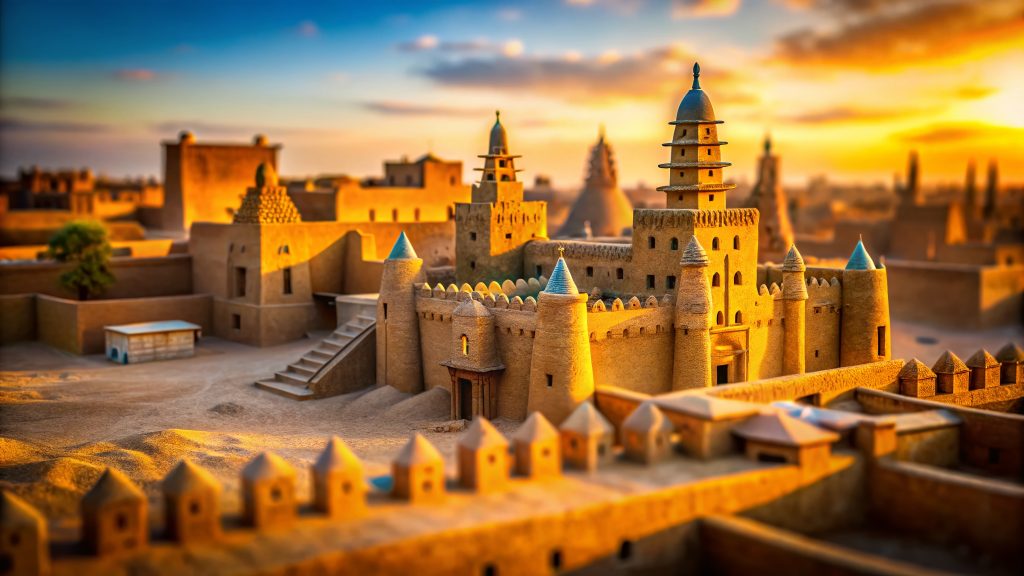
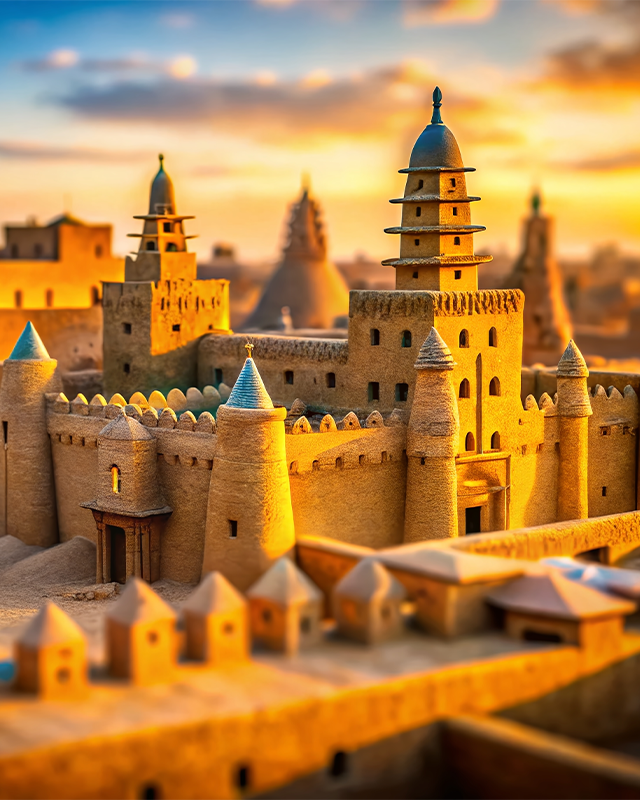
The legendary city of Timbuktu, historically known as the "Jewel of the Desert," is located in Mali, West Africa, on the edge of the Sahara Desert near the Niger River. This city was not merely a stop on a trade route; it was an intellectual and scholarly hub whose light shone across the African continent and the Islamic world for centuries.
1. Foundation and Economic Prosperity (The Gateway of Gold and Salt)
Timbuktu was founded in the 5th century AH (11th century CE) as a seasonal camp for the Tuareg tribes. It gained economic fame due to its unique strategic location as a crossroads for trans-Saharan trade caravans.
Gold: Timbuktu served as the main transit point for gold traveling from South Africa (the Mali and Songhai empires) to the North.
Commodities: Trade in salt (coming from the North), slaves, and spices flourished here, bringing immense wealth to the city and making it the focus of European attention (who imagined it as a "city of gold").
2. The Islamic Golden Age (The African Lighthouse of Knowledge)
Timbuktu's true value lies not in its material wealth, but in its status as the largest centre for Islamic education and civilization in West Africa.
Mansa Musa: Its prosperity peaked in the 14th century CE after the powerful Sultan Mansa Musa (from the Mali Empire) annexed it to his kingdom following his return from Hajj in 1324. He brought scholars and engineers, and built mosques and madrasas (schools).
Educational Centres: The city housed nearly 200 Quranic schools and universities, such as the Sankore Mosque, which transformed into a global educational institution, attracting students and scholars from all corners of the Islamic world, including the Maghreb and Egypt.
Scholars: Leading figures in jurisprudence (Fiqh) and history emerged, most famously Ahmad Baba al-Timbukti, the jurist and genealogist known for his prolific scholarly output.
3. Why Timbuktu is a Significant Islamic City
Timbuktu's status transcends geography for several reasons:
Manuscript Treasure: The city serves as a massive historical repository, with its private and public libraries preserving over 300,000 Arabic and African manuscripts. These manuscripts cover religious sciences, jurisprudence, history, literature, medicine, astronomy, and mathematics. They are concrete proof of a documented, ancient African culture and its contribution to global Islamic civilization.
Dawah Centre: Timbuktu was a radiating centre for religious outreach. From here, Dawah (preaching)campaigns spread Islam southward and westward across the continent, reinforcing the idea that Islam in Africa was not merely imported but locally produced and developed.
Cultural Coexistence: The city embodied a model of coexistence between local traditions and Islamic teachings, yielding a complex and thriving society that brought together various African ethnicities (Tuareg, Songhai, Fula, and others).
Conclusion: Timbuktu is not just an archaeological site; it is a symbol of the African Islamic Renaissance that proved that knowledge and scholarship flourished deep within the Sahara. Its legacy offers a strong counter-narrative to any notion that diminishes the civilizational role of West Africa in Islamic history.