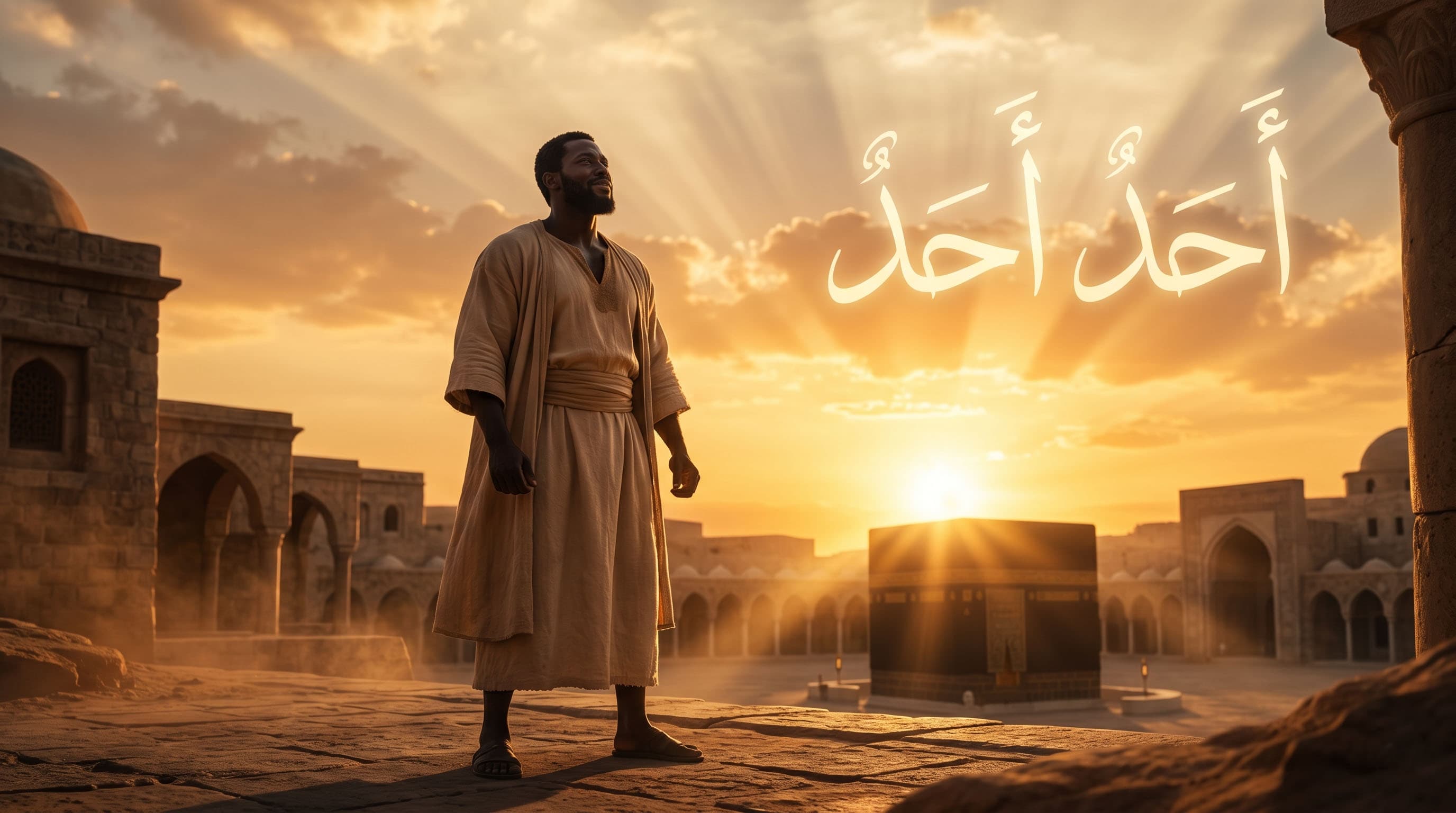
Some names are more than names. They are entire worldviews compressed into a word. Bilaal is such a name. The life of Bilaal ibn Rabah al-Habashi (may Allah be pleased with him) is one of the most extraordinary accounts in Islamic history: a story of a man who had everything taken from him, and who, through the power of faith, rose to heights that kings and nobles could not reach.
From the Sands of Abyssinia to the Streets of Makkah
Bilaal was born in Abyssinia, present-day Ethiopia, to a mother named Hamamah, who had been brought to Arabia as a slave. He grew up in bondage, owned by Umayyah ibn Khalaf, one of the most powerful and hostile enemies of early Islam. By all worldly measures, Bilaal had no status, no lineage, and no power.
But then the call of Islam reached him.
When Bilaal accepted the message of the Prophet Muhammad ﷺ, he did so knowing the consequences. His conversion was not merely a private spiritual decision but a declaration against the very system that had enslaved him, an assertion that no human being can truly own the soul of another.
Aḥad… Aḥad: The Word That Could Not Be Silenced
The punishment that followed was savage. Umayyah ibn Khalaf would drag Bilaal into the scorching heat of the Makkan desert, strip him, lay him on the burning sand, and place heavy rocks upon his chest, demanding that he renounce his faith and return to the worship of idols. But Bilaal's response never changed. A single word, exhaled from beneath the weight of the stones:
"Aḥad… Aḥad…" — "One… One…"
He was bearing witness to the Oneness of Allah in the most literal sense: with his body, his breath, and his blood. The Prophet ﷺ would later say of such steadfastness:
"The best fighting (jihad) in the path of Allah is (to speak) a word of justice to an oppressive ruler."
(Sunan Abi Dawud 4344, Book 39, Hadith 54)
Bilaal spoke that word not to a ruler but under a ruler's stone, and he did not stop saying it.
It was Abu Bakr al-Siddiq (may Allah be pleased with him) who purchased Bilaal's freedom, paying well above his price to liberate him solely for the sake of Allah. Years later, 'Umar ibn al-Khattab (may Allah be pleased with him) — by then the head of state — would say of the two of them:
`Umar used to say, "Abu Bakr is our chief, and he manumitted our chief," meaning Bilal.
(Sahih al-Bukhari 3754, Book 62, Hadith 99)
The First Voice of Islam: The Call to Prayer
After the migration to Madinah and the establishment of the first Muslim community, it came time to decide how to call the people to prayer. Various proposals were discussed. Then the Prophet ﷺ made a choice that would resound through history: he appointed Bilaal, a freed African slave, as the first muezzin of Islam.
Bilaal climbed to the highest point available and let his voice carry across Madinah for the first time:
"Allāhu Akbar, Allāhu Akbar — Allah is the Greatest, Allah is the Greatest…"
In a society defined by tribal hierarchy and racial distinction, this was a profound statement. The voice calling the community to its Lord was not the voice of an Arab nobleman. It was the voice of a man from Africa who had been tortured for his faith. The message could not have been clearer. Allah affirms this principle in His Book:
"O mankind! We created you from a single (pair) of a male and a female, and made you into nations and tribes, that ye may know each other (not that ye may despise (each other). Verily the most honoured of you in the sight of Allah is (he who is) the most righteous of you. And Allah has full knowledge and is well acquainted (with all things)."
(Surah Al-Hujurat, 49:13)
In Islam, the measure of a human being is their relationship with Allah, not their ancestry, complexion, or social standing.
The Sound of Sandals in Paradise
Among the most moving moments in the life of Bilaal is what the Prophet ﷺ revealed to him one morning after the Fajr prayer. He ﷺ said:
"Tell me of the best deed you did after embracing Islam, for I heard your footsteps in front of me in Paradise."
(Sahih al-Bukhari 1149, Book 19, Hadith 30)
Bilaal, with the humility of one who truly knows their Lord, replied that the deed he placed most hope in was this: that whenever he made wudu, at any hour of the day or night, he would follow it with two rak'ahs of prayer. A simple, consistent act of devotion. No grand gestures, no extraordinary display, just presence and continuity before Allah.
This is the Sunnah of Bilaal: two rak'ahs after every ablution, maintained across a lifetime. And this was enough to place his footsteps in Paradise before the Prophet ﷺ himself.
Standing Atop the Ka'bah
On the day Makkah was conquered, the very city where Bilaal had been dragged across burning sand, the Prophet ﷺ instructed him to climb to the roof of the Ka'bah and make the call to prayer. He stood at the highest point of the holiest house on earth and called out to Allah from the city that had tried to destroy him.
It was a moment of breathtaking symbolism. The man who had been crushed beneath heavy stones now stood above them. The voice they had tried to silence now echoed across the entire valley of Makkah. The Qur'an had already promised this:
"We will, without doubt, help our messengers and those who believe, (both) in this world's life and on the Day when the Witnesses will stand forth,-"
(Surah Ghafir, 40:51)
A Legacy That Belongs to Africa
Bilaal ibn Rabah is a permanent testament to the Islamic principle that faith elevates. He came from Africa. He was enslaved. He was tortured. And yet, by the mercy of Allah and the sincerity of his heart, he became one of the most beloved companions of the Prophet ﷺ, with a confirmed place in Paradise.
His story belongs especially to the Muslim communities of Africa and to all those who have ever been marginalised, oppressed, or told that their voice does not matter. It says to them, in the clearest terms: Aḥad — there is One who sees you, and He does not judge by what the world judges by.
May Allah be pleased with Bilaal ibn Rabah, and may his legacy continue to inspire every generation of believers, in Africa and across the world.