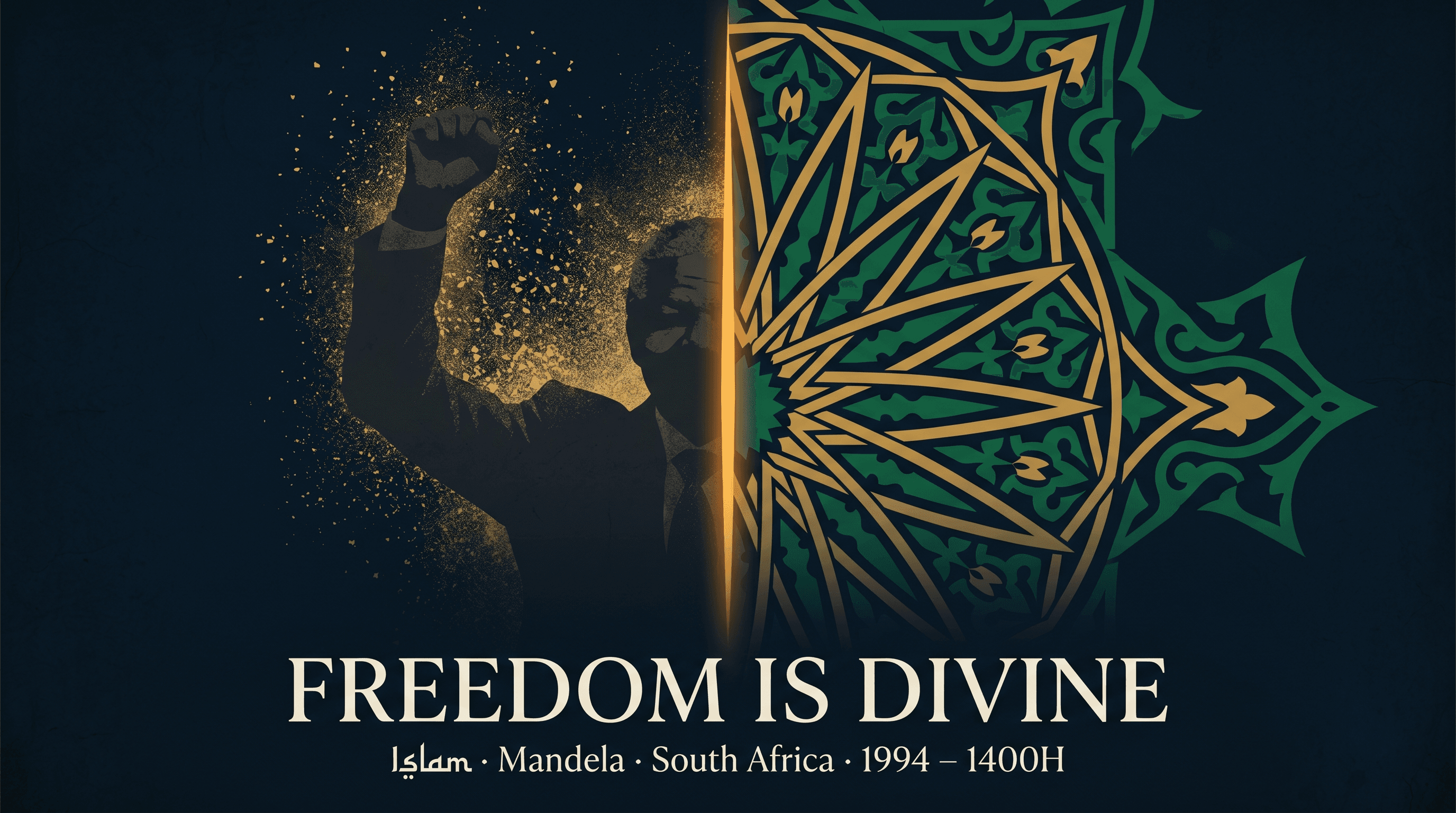
Freedom is one of the most powerful words in any language. It has ignited revolutions, inspired poetry, and given condemned men the strength to endure the darkest of prisons. In South Africa, no name is more synonymous with the pursuit of freedom than Nelson Rolihlahla Mandela, a man who spent 27 years behind bars and emerged not broken, but transformed, to lead a nation out of the shadows of apartheid.
Yet long before Mandela walked out of Victor Verster Prison, long before the ANC was formed, long before the first ship of colonisers ever anchored off the Cape of Good Hope, Islam had already established freedom as a sacred, inviolable right embedded in the very purpose of human creation.
This article explores that connection: between the Islamic understanding of freedom and the timeless struggle for human dignity that Nelson Mandela came to embody, a struggle that resonates deeply with the Muslim communities of South Africa who have called this land home for over three centuries.
1. The Islamic Foundation of Human Freedom
Islam's approach to freedom is not borrowed from Enlightenment philosophy or modern political theory. It springs from a far older and deeper source: the relationship between the Creator and the human being He fashioned with His own hands and into whom He breathed of His Spirit.
Allah ﷻ honoured humanity above all creation:
"We have honoured the sons of Adam; provided them with transport on land and sea; given them for sustenance things good and pure; and conferred on them special favours, above a great part of our creation."
(Surah Al-Isra' 17:70)
This honour, karamah, is the bedrock of Islamic freedom. It means that no human being can be reduced to a tool, a commodity, or the property of another. Oppression, enslavement of the mind, and the crushing of human dignity are not merely political injustices in Islam but theological violations against the order of Allah ﷻ.
Perhaps the most striking declaration of human freedom in Islamic history came from 'Umar ibn al-Khattab (رضي الله عنه), the second Caliph, who said in one of the most celebrated statements in the tradition:
"Since when have you enslaved people, when their mothers gave birth to them free?"
('Umar ibn al-Khattab رضي الله عنه, addressing 'Amr ibn al-'As over his son's mistreatment of an Egyptian Copt — a historical report (athar), not a hadith of the Prophet ﷺ, recorded in Ibn 'Abd al-Hakam's Futuh Misr and Ibn Kathir's Al-Bidayah wa'n-Nihayah)
These words, spoken over fourteen centuries ago in Egypt, could have been spoken in Cape Town, in Johannesburg, in Soweto. They echo with the same moral outrage that drove Mandela and his generation, the outrage of free souls reduced to second-class citizens by the decree of men who had no such authority from God or nature.
2. Freedom from Servitude to Anything but Allah
The Qur'an's conception of freedom is not merely the absence of chains but the liberation of the human soul from servitude to anything other than Allah ﷻ, from tyrannical rulers, from nafs (ego), from ideology, from systems designed to dehumanise.
"Let there be no compulsion in religion: Truth stands out clear from Error: whoever rejects evil and believes in Allah hath grasped the most trustworthy hand-hold, that never breaks. And Allah heareth and knoweth all things."
(Surah Al-Baqarah 2:256)
This verse, one of the most celebrated in the entire Qur'an, establishes that faith itself must be freely chosen. No political system, no church, no state has the right to coerce the human conscience. This is a principle that apartheid violated every single day: a system that compelled Black South Africans to live as strangers in their own land, with no voice, no vote, no dignity.
The Prophet Muhammad ﷺ further grounded this understanding of freedom in his farewell sermon, one of history's most remarkable human rights declarations, when he declared:
"There is no virtue of an Arab over a foreigner, nor a foreigner over an Arab, and neither white over black nor black over white, except by righteousness."
(The Prophet Muhammad ﷺ, Farewell Sermon — Shu'ab al-Iman 5137, narrated by Jabir ibn 'Abdullah, graded Sahih li ghayrihi by Al-Albani)
In a world built on racial hierarchies, in a South Africa carved up by racial legislation, these prophetic words carry the force of a thunderclap. The Prophet ﷺ dismantled racial supremacy at its root, 1,300 years before apartheid was formally codified.
3. Mandela's Struggle Seen Through an Islamic Lens
Nelson Mandela was not a Muslim. But the values that drove his life's work, dignity, justice, the refusal to accept oppression as inevitable, are values that any Muslim reading the Qur'an and Sunnah would immediately recognise.
"I have fought against white domination, and I have fought against black domination. I have cherished the ideal of a democratic and free society in which all persons live together in harmony and with equal opportunities. It is an ideal which I hope to live for and to achieve. But if needs be, it is an ideal for which I am prepared to die."
(Nelson Mandela — Statement from the dock, Rivonia Trial, 20 April 1964)
This willingness to sacrifice everything for justice is not foreign to the Islamic tradition. The Qur'an commands the believers to stand resolutely for justice even against themselves:
"O ye who believe! stand out firmly for justice, as witnesses to Allah, even as against yourselves, or your parents, or your kin, and whether it be (against) rich or poor: for Allah can best protect both. Follow not the lusts (of your hearts), lest ye swerve, and if ye distort (justice) or decline to do justice, verily Allah is well-acquainted with all that ye do."
(Surah An-Nisa' 4:135)
Mandela's 27 years on Robben Island parallel the Qur'anic reality that the path of justice often demands patient sacrifice. Allah ﷻ reminds us that the believers must not lose heart in the face of oppressive power:
"So lose not heart, nor fall into despair: For ye must gain mastery if ye are true in Faith."
(Surah Aal 'Imran 3:139)
Mandela's composure, his refusal to be embittered, and his capacity to forgive are what Muslims call sabr (patience) and 'adl (justice) in their most powerful human expression. When he walked out of prison on 11 February 1990, tall and unbroken, the world witnessed what it looks like when a person refuses to allow the oppressor to define them.
The Prophet ﷺ taught the same liberation from the prison of hatred. The one who forgives, who releases the burden of revenge from his chest, is the one who is truly free. This is the convergence between Islamic spirituality and the moral genius of Mandela, two streams arriving at the same truth about the human soul.
4. The Cape Malay Muslims: Islam and Freedom at the Cape
South Africa's Muslim community, particularly the Cape Malay Muslims (descendants of political exiles, scholars, and enslaved peoples brought from the East), were among the earliest to understand the convergence of Islamic values and the struggle for freedom in this land. (South African History Online, "Sheik Yusuf")
Sheikh Yusuf of Macassar, exiled to the Cape in 1694, is regarded as the father of Islam in South Africa. (South African History Online; The Presidency, "Sheik Yusuf (1626–1699)") He brought with him a tradition that refused to equate oppression with fate. The very act of preserving Islamic identity under colonial rule, the madrasas, the mosques, the Arabic manuscripts, was an act of resistance, of freedom asserted in the only spaces the oppressor could not fully control.
The Prophet ﷺ reminded the believers that community and solidarity are themselves forms of liberation:
"The believers in their mutual kindness, compassion, and sympathy are just like one body. When one of the limbs suffers, the whole body responds to it with wakefulness and fever."
(Prophet Muhammad ﷺ, narrated by An-Nu'man ibn Bashir — Sahih al-Bukhari 6011, Sahih Muslim 2586, Muttafaqun 'alayhi)
This is why South African Muslims could not remain silent under apartheid. The body of the Ummah was in pain. The suffering of one people is the suffering of all. Freedom, in Islam, is never a purely personal affair.
5. Freedom: A Responsibility, Not Just a Right
Islam's understanding of freedom carries with it a weight that modern liberal philosophy sometimes ignores: freedom is inseparable from accountability. The Qur'an presents freedom as the capacity to choose rightly, and as the responsibility that comes with that choice.
"We did indeed offer the Trust to the Heavens and the Earth and the Mountains; but they refused to undertake it, being afraid thereof: but man undertook it;- He was indeed unjust and foolish;-"
(Surah Al-Ahzab 33:72)
Commenting on this verse, Ibn Kathir records that Ibn 'Abbas explained the amanah as obedience and the obligatory duties (al-fara'id), and that Qatadah described it as religion itself, its duties and its prescribed limits: whoever fulfils this trust is rewarded, and whoever neglects it is answerable for it. (Tafsir Ibn Kathir, on Surah Al-Ahzab 33:72) Carrying that trust is only possible for a being who can choose whether to keep it or betray it, so the responsibility Ibn Kathir describes presupposes the very freedom this article has traced from the start. This is what gives freedom its weight and its dignity. It is also why Mandela, after his release, chose reconciliation over revenge. He understood that freedom used for destruction is not freedom; it is merely a change of oppressor.
"For to be free is not merely to cast off one's chains, but to live in a way that respects and enhances the freedom of others."
(Nelson Mandela — Long Walk to Freedom, p. 751)
This insight is profoundly Islamic. The Prophet ﷺ said: "A Muslim is the one who avoids harming Muslims with his tongue and hands." (Sahih al-Bukhari 10, Book 2, Hadith 3) True freedom, in both the Mandela and the Islamic vision, creates safety, not dominance, for others.
Conclusion: One Truth, Many Voices
Freedom, as Islam teaches it, is not a Western import or a modern discovery. It is woven into the fabric of human creation, the fitra, the innate nature with which every soul arrives in this world. It is the reason we were given reason, speech, and the capacity to choose between right and wrong.
Nelson Mandela, shaped by the red soil of the Transkei and the moral universe of African humanism, arrived at many of the same truths through a different path. His long walk to freedom was, in Islamic terms, the walk of a soul insisting on the honour that Allah ﷻ had already written into human nature.
In South Africa, where the call to prayer echoes from the Bo-Kaap over Cape Town, where Indian Muslim traders built shops and trading houses across the Witwatersrand within a decade of the 1886 gold discovery (Mahida, "History of Muslims in South Africa: 1804–1899", South African History Online), where generations of Muslim scholars taught in townships and villages, the Islamic vision of freedom is not an abstraction. It is a living inheritance. It is the task of every Muslim in this land to carry it forward: not only as theology, but as action, as service, as the perpetual refusal to accept that any human being is less than what Allah ﷻ created them to be.
"On that account: We ordained for the Children of Israel that if any one slew a person - unless it be for murder or for spreading mischief in the land - it would be as if he slew the whole people: and if any one saved a life, it would be as if he saved the life of the whole people. Then although there came to them Our messengers with clear signs, yet, even after that, many of them continued to commit excesses in the land."
(Surah Al-Ma'idah 5:32)
Written for the Muslim communities of South Africa — in the spirit of the Qur'an, the Sunnah, and the enduring legacy of Madiba.
Amandla. Awethu. ("Power. To the people.")
Sources Used
- The Qur'an: 17:70, 2:256, 4:135, 3:139, 33:72 and 5:32. Quotations are from the translation of Abdullah Yusuf Ali on quran.com.
- Sahih al-Bukhari 10 (Book 2, Hadith 3); Sahih al-Bukhari 6011, Sahih Muslim 2586 (believers as one body); Shu'ab al-Iman 5137 (graded Sahih li ghayrihi by Al-Albani — the Farewell Sermon on race).
- 'Umar ibn al-Khattab رضي الله عنه — historical report (athar) recorded in Ibn 'Abd al-Hakam's Futuh Misr and Ibn Kathir's Al-Bidayah wa'n-Nihayah.
- Tafsir Ibn Kathir, on Surah Al-Ahzab 33:72.
- Nelson Mandela: Statement from the dock, Rivonia Trial (20 April 1964, official UN transcript); Long Walk to Freedom, p. 751.
- South African History Online, "Sheik Yusuf"; The Presidency, "Sheik Yusuf (1626–1699)"; Mahida, E. M., "History of Muslims in South Africa: 1804–1899" (South African History Online).