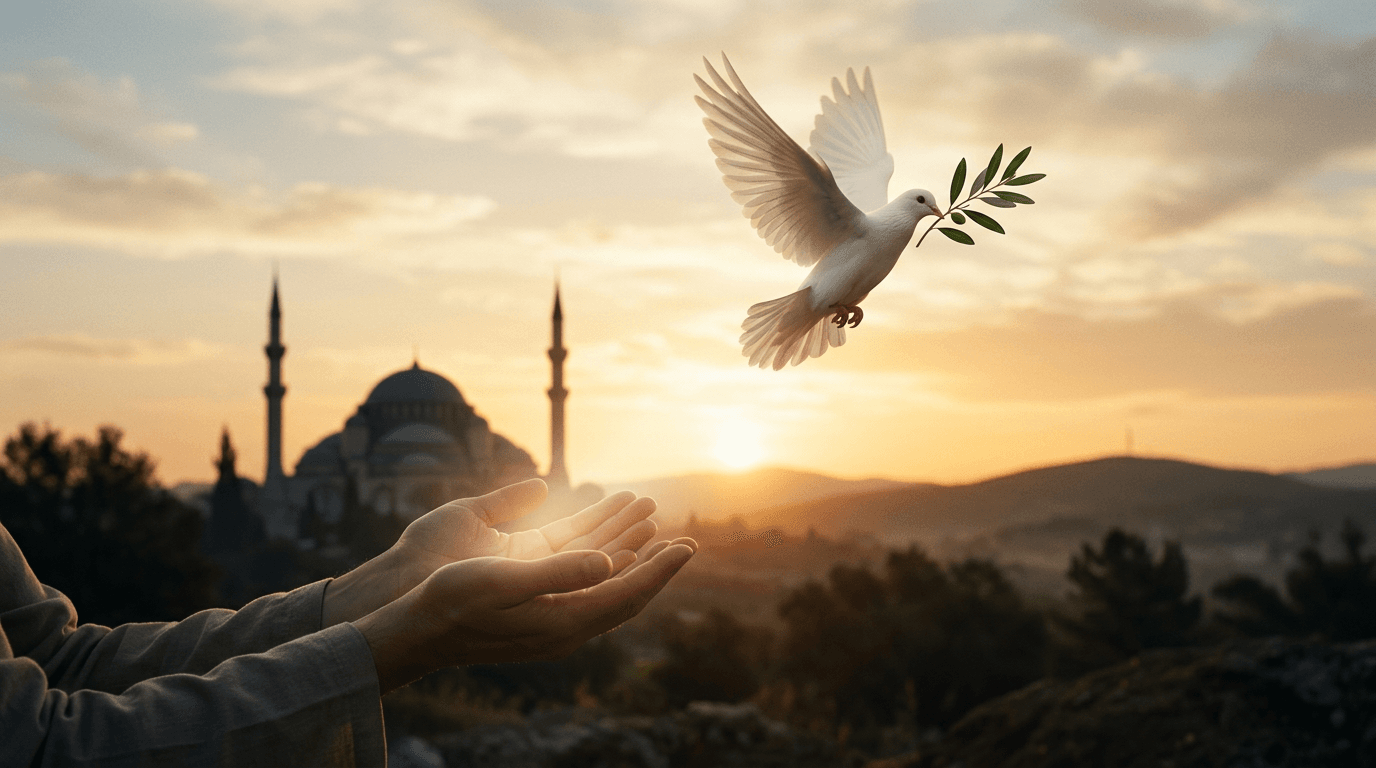
Start with the word itself. Islam comes from the same Arabic root as salām, peace. A Muslim's daily greeting is as-salāmu 'alaykum, "peace be upon you." One of God's own names in the Qur'an is As-Salām, the Source of Peace (Surah Al-Hashr, 59:23). Peace is not a slogan added to Islam from outside; it is woven into its vocabulary, its greeting, and its goal, peace with God, and peace among people.
What the Qur'an Teaches
The Qur'an sets the sanctity of human life at the centre of its moral law:
"On that account: We ordained for the Children of Israel that if any one slew a person - unless it be for murder or for spreading mischief in the land - it would be as if he slew the whole people: and if any one saved a life, it would be as if he saved the life of the whole people. Then although there came to them Our messengers with clear signs, yet, even after that, many of them continued to commit excesses in the land."
(Surah Al-Ma'idah, 5:32)
It commands justice even toward enemies, "let not the hatred of others to you make you swerve to wrong and depart from justice. Be just: that is next to piety" (Surah Al-Ma'idah, 5:8), and it states plainly that faith can never be forced: "Let there be no compulsion in religion" (Surah Al-Baqarah, 2:256). It even instructs believers to meet an enemy's turn toward peace with peace: "if the enemy incline towards peace, do thou (also) incline towards peace, and trust in Allah" (Surah Al-Anfal, 8:61).
So Why Does the Qur'an Talk About Fighting?
Honestly: because it is a complete way of life, revealed to a real community that was persecuted, expelled, and attacked. Islam permits fighting in defined circumstances (self-defence and the protection of the oppressed) under strict rules, the way just-war principles work in other traditions. Permission came with its reason attached: "permission is given (to fight), because they are wronged" (Surah Al-Hajj, 22:39). And its limit: "Fight in the cause of Allah those who fight you, but do not transgress limits; for Allah loveth not transgressors" (Surah Al-Baqarah, 2:190).
Even then, the Prophet ﷺ forbade harming women, children, the elderly, monks in their monasteries, even the wanton destruction of trees and crops. And whoever kills a person living peacefully under Muslim protection, he warned, "will not smell the fragrance of Paradise" (Sahih al-Bukhari, 3166). Terrorism, the deliberate targeting of innocents, is not an "extreme version" of these teachings; it is their direct violation, and Muslim scholars worldwide have condemned it as such.
The Prophet's ﷺ Own Example
For thirteen years in Makkah, the Prophet ﷺ and his followers were tortured and boycotted, and answered with patience, not one act of vengeance. And when he finally returned to Makkah in 630 CE at the head of ten thousand, with his former persecutors at his mercy, he asked them: "What do you think I will do with you?" Then he said: "Go, for you are free." The conquest of Makkah is remembered as one of history's most famous acts of mass forgiveness.
In One Sentence
Yes, Islam is a religion whose name, greeting, and goal is peace; it permits defensive fighting under strict limits, and it counts the killing of the innocent among the gravest of all sins.
Learn More
- Common Misconceptions About Islam. Including jihad, terrorism, and other frequent questions, answered honestly.
- Who Is Prophet Muhammad ﷺ? The character behind the example.
Continue Your Journey
Part of the Bilaal TV Islamic Knowledge Hub.