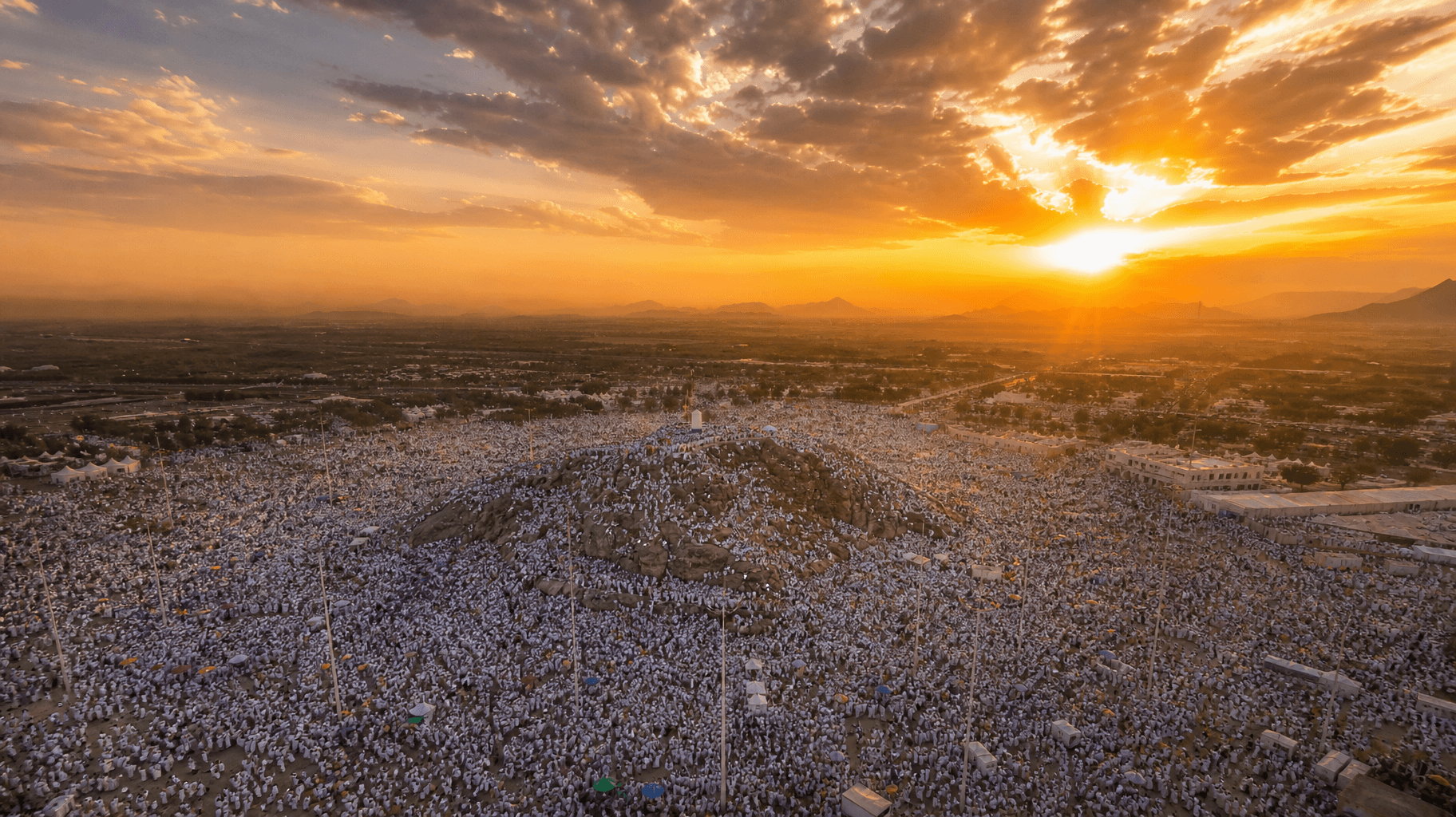
The 9th of Dhul Hijjah is the Day of Arafah. It is the pinnacle of Hajj, and its blessing reaches far beyond the pilgrims standing on the plains of Arafah. For over 1.8 billion Muslims, this day is an invitation from Allah to be forgiven, freed from the Fire, and drawn near to Him.
Ibn al-Qayyim رحمه الله said: "The Day of Arafah is the day of completion, honour, and drawing near to Allah."
The Virtues of the Day of Arafah (ما فضله؟)
Five blessings belong to this day alone:
- Allah frees the greatest number of people from the Fire, more than on any other day of the year. (Sahih Muslim 1348)
- Allah draws near to His servants and boasts about them to the angels.
- The religion of Islam was completed on this day with the revelation of Al-Ma'idah 5:3, the final great verse of the Qur'an.
- Fasting it expiates two years of sins, the year before and the year after. (Sahih Muslim 1162a)
- Du'a is more likely to be answered on this day than any other. The Prophet ﷺ called it the best day for supplication.
Ibn Rajab al-Hanbali رحمه الله wrote: "The Day of Arafah is the greatest day of the year for the one who is not performing Hajj, just as the Night of Qadr is the greatest night of the year."
From the Qur'an and Sunnah
1. The Day of Completion of the Deen
Allah ﷻ revealed His most celebrated verse on this very day:
ٱلْيَوْمَ أَكْمَلْتُ لَكُمْ دِينَكُمْ وَأَتْمَمْتُ عَلَيْكُمْ نِعْمَتِى وَرَضِيتُ لَكُمُ ٱلْإِسْلَـٰمَ دِينًۭا
"This day have I perfected your religion for you, completed My favour upon you, and have chosen for you Islam as your religion."
(Surah Al-Ma'idah 5:3)
'Umar ibn al-Khattab رضي الله عنه narrated: "Once a Jew said to me, 'O the chief of believers! There is a verse in your Holy Book which is read by all of you (Muslims), and had it been revealed to us, we would have taken that day (on which it was revealed) as a day of celebration.' 'Umar bin Al-Khattab asked, 'Which is that verse?' The Jew replied, 'This day I have perfected your religion for you, completed My favor upon you, and have chosen for you Islam as your religion.' (5:3) 'Umar replied, 'No doubt, we know when and where this verse was revealed to the Prophet. It was Friday and the Prophet was standing at 'Arafat (i.e. the Day of Hajj).'" (Sahih al-Bukhari 45)
2. The Oath of the Even and the Odd
وَٱلْفَجْرِ وَلَيَالٍ عَشْرٍ وَٱلشَّفْعِ وَٱلْوَتْرِ
"By the break of Day By the Nights twice five; By the even and odd (contrasted);"
(Surah Al-Fajr 89:1–3)
Ibn 'Abbas رضي الله عنهما explained: "The ten nights are the first ten days of Dhul Hijjah. The odd is the Day of Arafah, and the even is the Day of Sacrifice (Eid al-Adha)." Allah ﷻ swears by this day.
3. The Greatest Day of the Year
The Prophet ﷺ said: "There is no day when God sets free more servants from Hell than the Day of 'Arafa. He draws near, then praises them to the angels, saying: What do they want?" (Sahih Muslim 1348)
4. Expiation of Two Years of Sins
The Prophet ﷺ said: "I seek from Allah that fasting on the day of 'Arafa may atone for the sins of the preceding and the coming years." (Sahih Muslim 1162a)
This is for those not performing Hajj. One day of fasting wipes away two years of minor sins. There is no easier path to forgiveness in the entire year.
5. The Pillar of Hajj
The Prophet ﷺ said: "Hajj is Arafah." (Abu Dawud & Tirmidhi — Sahih)
To stand on Arafah is to fulfil the essence of the pilgrimage. Without it, there is no Hajj.
How the Companions Spent the Day of Arafah
The Companions رضي الله عنهم treated Yawm Arafah as an encounter with Allah.
'Umar ibn al-Khattab رضي الله عنه
When the verse of completion of the Deen was revealed on this day, 'Umar wept. The Prophet ﷺ asked him why, and he replied: "Because our religion has now been completed — and nothing is complete except that it begins to diminish." 'Umar saw the weight of responsibility in this day.
Ibn 'Abbas رضي الله عنهما
He taught people the meanings and virtues of this day: the Qur'anic oaths, the significance of the ten nights, and the inner dimensions of standing at Arafah.
'A'ishah رضي الله عنها
She reported that the Prophet ﷺ would fast the Day of Arafah when not on Hajj, and she herself continued this practice. She described it as a day of intense du'a and dhikr. The Prophet ﷺ would raise his hands in supplication, turning to Allah with complete focus and hope.
'Abdullah ibn 'Umar رضي الله عنهما
He watched the Prophet ﷺ closely on the Day of Arafah, and spent the day himself fasting, making du'a, and reciting the talbiyah until the sun set.
How the Tabi'een Revived This Day
Sa'id ibn Jubayr رحمه الله
Among the greatest of the Tabi'een, he would not cease his du'a from Dhuhr until sunset, following the Sunnah of the Prophet ﷺ, who stood supplicating at Arafah until the stars appeared. He said: "I met seventy companions of the Messenger of Allah ﷺ — they all agreed that the best supplication on the Day of Arafah was: La ilaha illallah alone."
Imam Sa'id ibn al-Musayyib رحمه الله
He fasted the first nine days of Dhul Hijjah every year without exception, saying: "I have not missed fasting these days in forty years." For him, the Day of Arafah was the culmination of the nine.
Imam al-Hasan al-Basri رحمه الله
He would remind his students: "Arafah is not only for the one who stands on its soil. Arafah is a station of the heart — stand before Allah in your home as the pilgrims stand, with the same brokenness and hope."
'Ata ibn Abi Rabah رحمه الله
He fasted this day even while teaching and said: "If a man supplicates on the Day of Arafah with a sincere heart, he would not find it in himself to doubt that Allah has answered him."
The Rulings of the Day of Arafah (أحكام يوم عرفة)
For Those Not on Hajj
- Fasting is a confirmed Sunnah. The Prophet ﷺ consistently fasted this day when not on Hajj, and it expiates two years of sins.
- Abundant dhikr and du'a from Fajr through sunset, especially from Dhuhr until Maghrib, which mirrors the standing time at Arafah.
- Takbeer, Tahmeed, Tahleel, and Tasbih. Increase: Allahu Akbar, Alhamdulillah, La ilaha illallah, SubhanAllah.
- Charity and good deeds. Any righteous act in the ten days of Dhul Hijjah is more beloved to Allah than the same act at any other time.
- Cutting hair and nails is disliked from the 1st of Dhul Hijjah for those intending to sacrifice an Udhiyah. (Sahih Muslim 1977d)
For Pilgrims on Hajj
- Fasting is prohibited for the pilgrim on this day. They need their strength for the standing (wuquf).
- The pilgrim must be present at Arafah between Dhuhr and sunset. This is the pillar (rukn) of Hajj, without which the Hajj is invalid.
Supplications on the Day of Arafah (دعاء يوم عرفة)
The Prophet ﷺ described a great reward for whoever repeats these words a hundred times in a day: the reward of freeing ten slaves, a hundred good deeds written, a hundred sins erased, and a shield from Satan until nightfall.
لَا إِلَهَ إِلَّا اللهُ وَحْدَهُ لَا شَرِيكَ لَهُ، لَهُ الْمُلْكُ وَلَهُ الْحَمْدُ وَهُوَ عَلَى كُلِّ شَيْءٍ قَدِيرٌ
Lā ilāha illallāhu waḥdahu lā sharīka lah, lahul mulku wa lahul ḥamdu wa huwa ʿalā kulli shay'in qadīr
"There is no Deity but Allah, Alone, no Partner to Him. His is the Kingdom and all praise, and Omnipotent is he."
(Sahih al-Bukhari 6403, Book 80, Hadith 98 · English rendering: Sahih al-Bukhari 844, Book 10, Hadith 236)
The reward in Bukhari 6403 is stated generally, and the hadith does not mention the Day of Arafah.
For Forgiveness
اللَّهُمَّ إِنَّكَ عَفُوٌّ كَرِيمٌ تُحِبُّ الْعَفْوَ فَاعْفُ عَنِّي
Allāhumma innaka ʿafuwwun karīmun tuḥibbul ʿafwa faʿfu ʿannī
"O Allah, You are Pardoning and Generous, You love to pardon, so pardon me."
For Good in This World and the Next
رَبَّنَا آتِنَا فِي الدُّنْيَا حَسَنَةً وَفِي الْآخِرَةِ حَسَنَةً وَقِنَا عَذَابَ النَّارِ
Rabbanā ātinā fid-dunyā ḥasanatan wa fil-ākhirati ḥasanatan wa qinā ʿadhāban-nār
"Our Lord! Give us good in this world and good in the Hereafter, and defend us from the torment of the Fire!"
(Al-Baqarah 2:201 — the most frequently recited du'a of the Prophet ﷺ)
For Protection from the Fire
An authentic du'a of the Prophet ﷺ. It is general, is not reported as belonging to Arafah, and may be said on this day or any other:
اللَّهُمَّ إِنِّي أَعُوذُ بِكَ مِنْ عَذَابِ الْقَبْرِ، وَمِنْ عَذَابِ النَّارِ، وَمِنْ فِتْنَةِ الْمَحْيَا وَالْمَمَاتِ، وَمِنْ فِتْنَةِ الْمَسِيحِ الدَّجَّالِ
Allāhumma innī a'ūdhu bika min 'adhābi-l-qabr, wa min 'adhābi-n-nār, wa min fitnati-l-maḥyā wa-l-mamāt, wa min fitnati-l-masīḥi-d-dajjāl
"O Allah! I seek refuge with you from the punishment in the grave and from the punishment in the Hell fire and from the afflictions of life and death, and the afflictions of Al-Masih Ad-Dajjal."
(Sahih al-Bukhari 1377, Book 23, Hadith 129)
For the Ummah
Do not forget to make du'a for your family, your parents, the sick, those in hardship, and the entire Muslim ummah, especially those suffering around the world. The du'a of a Muslim for his brother in his absence is answered. (Muslim 2732)
Practical tip: Write down your du'as before the day. When Dhuhr enters, put away your phone, find a quiet place, raise your hands, and speak to Allah directly, in your own words, in any language, from your heart.
What We Should Do on This Day
1. Fast
Begin your fast from Fajr. This single act carries the reward of expiation for two years.
2. Fill the Day with Dhikr
Increase the following from Fajr throughout the day:
- Lā ilāha illallāhu waḥdahu lā sharīka lah, lahul mulku wa lahul ḥamdu wa huwa ʿalā kulli shay'in qadīr
- SubhanAllah · Alhamdulillah · Allahu Akbar · La ilaha illallah
3. Make Du'a from Dhuhr to Maghrib
This window mirrors the standing time at Arafah. Make sincere, focused supplication for yourself, your family, and the ummah.
4. Repent Sincerely
Come with your sins and leave them at the door of His mercy. Allah draws near on this day. Do not let it pass without turning to Him.
5. Give in Charity
Any righteous act on these days is multiplied. Even a small sadaqah carries more weight today.
6. Connect Your Family
Gather your household for a moment of du'a before sunset. Call absent family members.
A Final Reflection
Allah does not wait for us to be perfect. He frees masses of people from the Fire on this day, not because they have earned it, but because they turned to Him.
The Prophet ﷺ stood at Arafah and wept in supplication as the sun descended. The Companions stood with him, weeping, begging, hoping.
We may not be at Arafah this year, but we can stand before Allah wherever we are, with the same need, the same hope, and the same certainty that He hears.
وَإِذَا سَأَلَكَ عِبَادِى عَنِّى فَإِنِّى قَرِيبٌ ۖ أُجِيبُ دَعْوَةَ ٱلدَّاعِ إِذَا دَعَانِ
"When My servants ask thee concerning Me, I am indeed close (to them): I listen to the prayer of every suppliant when he calleth on Me"
(Al-Baqarah 2:186)
Make the most of the 9th of Dhul Hijjah.