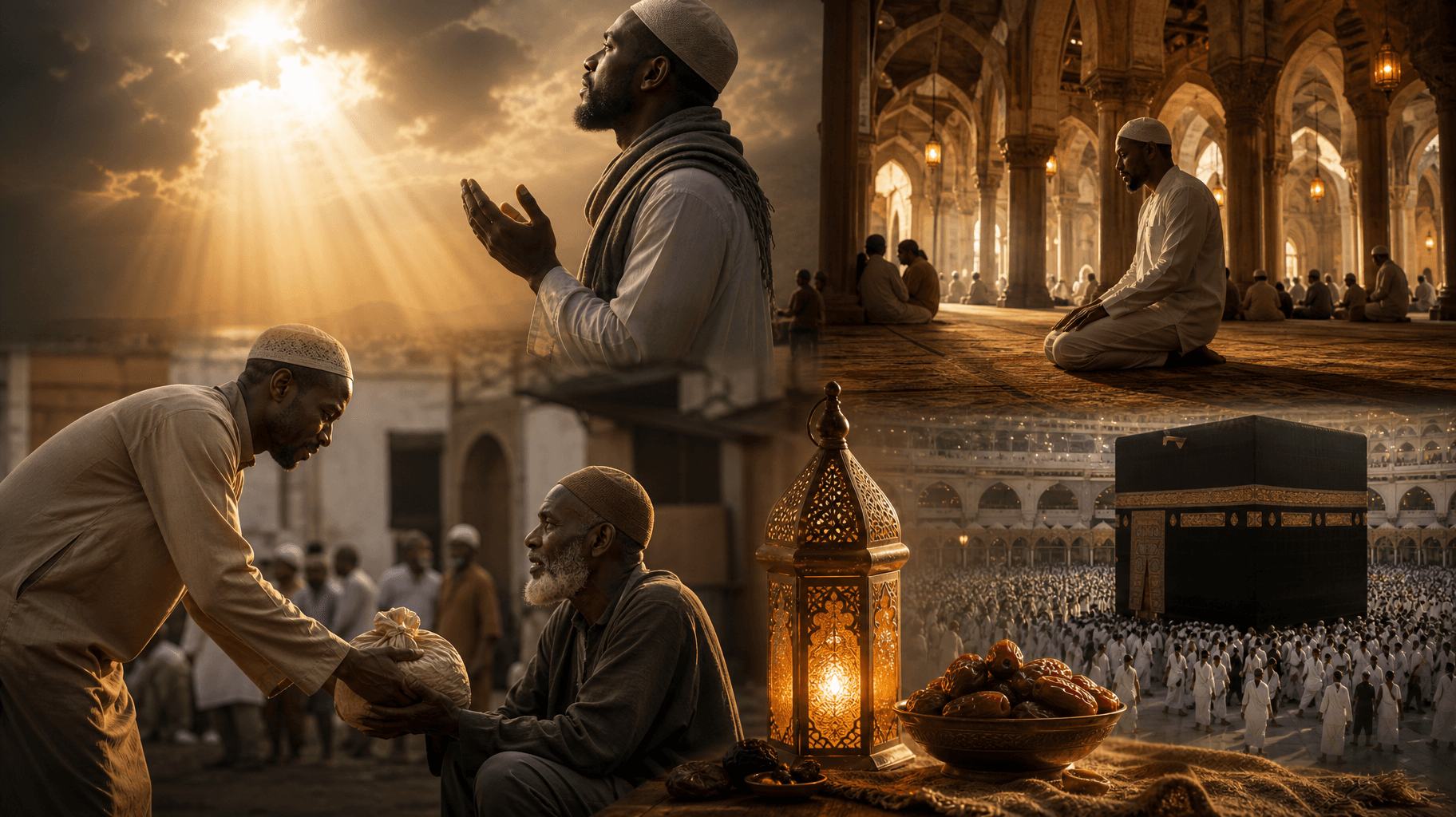
If belief is the heart of Islam, the Five Pillars are its framework, the acts of worship that turn conviction into a way of life. The Prophet Muhammad ﷺ described them in a famous saying:
"Al-Islam implies that you testify that there is no god but Allah and that Muhammad is the messenger of Allah, and you establish prayer, pay Zakat, observe the fast of Ramadan, and perform pilgrimage to the (House) if you are solvent enough (to bear the expense of) the journey."
(Sahih Muslim 8a, Book 1, Hadith 1)
1. Shahadah: The Declaration of Faith
The first pillar is a simple statement that carries the entire weight of the religion: Ashhadu an lā ilāha illā Allāh, wa ashhadu anna Muhammadan rasūlullāh, "I bear witness that there is no god but Allah, and I bear witness that Muhammad is the Messenger of Allah."
To say these words with sincere conviction is to become a Muslim. The first half affirms tawhīd, that God is one and worship belongs to Him alone; the second affirms that Muhammad ﷺ is His messenger, whose guidance is to be followed. Every other pillar flows from this one.
2. Salah: The Five Daily Prayers
Muslims pray five times a day, at dawn, midday, afternoon, sunset, and night, facing the Ka'bah in Makkah. Prayer is a direct line between the worshipper and God, requiring no priest and no intermediary. It punctuates the day with remembrance, pulling a person out of the rush of life to stand, bow, and prostrate before their Creator.
"Recite what is sent of the Book by inspiration to thee, and establish regular Prayer: for Prayer restrains from shameful and unjust deeds; and remembrance of Allah is the greatest (thing in life) without doubt. And Allah knows the (deeds) that ye do."
(Surah Al-'Ankabut, 29:45)
The Prophet ﷺ compared it to a cleansing river. He asked his companions: "If there was a river at the door of anyone of you and he took a bath in it five times a day would you notice any dirt on him?" They answered that none would remain. He said that the five prayers wash away sins in the same way. (Sahih al-Bukhari 528, Book 9, Hadith 7)
3. Zakah: Obligatory Charity
Zakah is a fixed portion, generally 2.5%, of the wealth a Muslim has held for a year, given to the poor and other deserving categories. It is not a tax to the state but an act of worship: a recognition that all wealth ultimately belongs to God, and that the fortunate owe a share to those in need.
"Of their goods, take alms, that so thou mightest purify and sanctify them; and pray on their behalf. Verily thy prayers are a source of security for them: And Allah is One Who heareth and knoweth."
(Surah At-Tawbah, 9:103)
The word zakāh itself means "purification" and "growth", for it purifies the giver's wealth and heart of greed, and, the Qur'an promises, causes true increase.
4. Sawm: Fasting the Month of Ramadan
For one month each year, healthy adult Muslims fast from dawn until sunset, abstaining from food, drink, and intimacy, devoting themselves to prayer, the Qur'an, and self-restraint. Fasting builds discipline, empathy for the hungry, and, above all, taqwā, God-consciousness.
"O ye who believe! Fasting is prescribed to you as it was prescribed to those before you, that ye may (learn) self-restraint,-"
(Surah Al-Baqarah, 2:183)
Ramadan is also the month in which the Qur'an was first revealed, making it a season of intense spiritual renewal for Muslims worldwide.
5. Hajj: The Pilgrimage to Makkah
Once in a lifetime, every Muslim who is physically and financially able must make the pilgrimage to Makkah. During Hajj, millions of people, of every race and nation, dressed in simple white garments that erase all distinction of rank and wealth, gather to worship God together, retracing the footsteps of the Prophet Abraham and his family.
"In it are Signs Manifest; (for example), the Station of Abraham; whoever enters it attains security; Pilgrimage thereto is a duty men owe to Allah,- those who can afford the journey; but if any deny faith, Allah stands not in need of any of His creatures."
(Surah Aal 'Imran, 3:97)
Hajj is a powerful image of human equality and unity: kings and labourers standing shoulder to shoulder, indistinguishable, before the one God.
Further Reading
- The Qur'an. Read it for yourself, with translation and recitation.
- Sahih al-Bukhari & Sahih Muslim. The two most rigorously authenticated collections of the Prophet's ﷺ sayings.
- Riyad as-Salihin (Imam an-Nawawi), a beloved anthology of hadith on faith, character, and worship.
- The Sealed Nectar (Ar-Raheeq Al-Makhtum), an award-winning biography of the Prophet ﷺ.
- Muhammad: His Life Based on the Earliest Sources. Martin Lings.