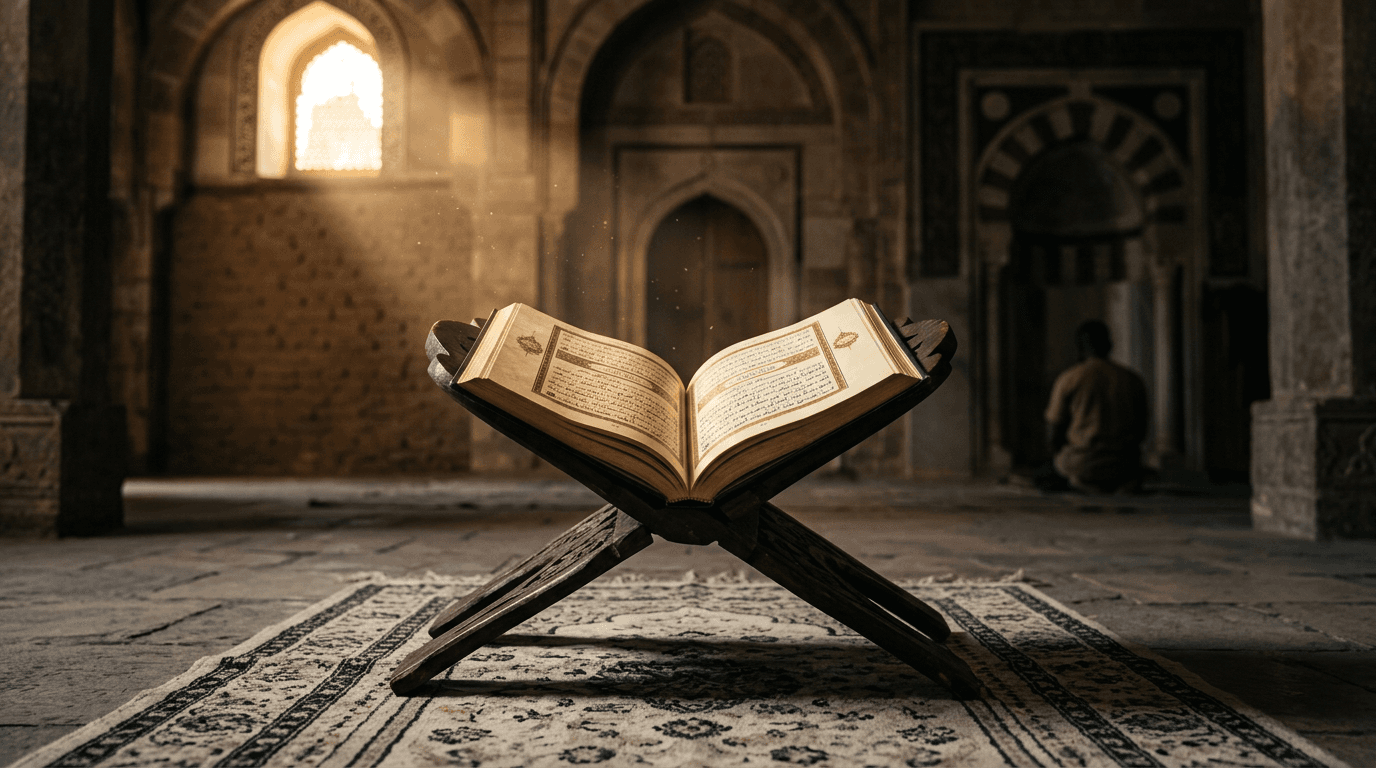
Every prophet was given a miracle that spoke to the strengths of his people. In the time of Moses, magic was mastered, so his miracle overpowered the magicians. In the time of Jesus, medicine was prized, so he healed the blind and the leper by God's permission. In the time of Muhammad ﷺ, the Arabs were unrivalled masters of language and poetry. And so his miracle was not a staff or a healing hand, but a book: the Qur'an.
What Is the Qur'an?
The Qur'an is the sacred scripture of Islam: the literal, unaltered word of God, revealed to the Prophet Muhammad ﷺ through the angel Gabriel over a period of about twenty-three years. It is not a biography of the Prophet ﷺ, nor a book written by him. He was the receiver of it, not its author, which is why the Qur'an speaks to him and even, at times, gently corrects him.
The Qur'an describes itself, from its opening pages, as a source of guidance beyond doubt:
"This is the Book; in it is guidance sure, without doubt, to those who fear Allah;"
(Surah Al-Baqarah, 2:2)
A Book Preserved, Word for Word
Perhaps the most remarkable fact about the Qur'an is its preservation. From the moment each verse was revealed, it was both written down by scribes and memorised by heart. To this day, millions of Muslims, of every nationality, many of whom do not even speak Arabic, have committed the entire Qur'an to memory, word for word. A child in Nigeria, an elder in Indonesia, and a student in Egypt will recite it identically.
This is no accident. God Himself promised to guard it:
"We have, without doubt, sent down the Message; and We will assuredly guard it (from corruption)."
(Surah Al-Hijr, 15:9)
The result is that the Qur'an recited today is, letter for letter, the same text recited by the Prophet ﷺ over fourteen hundred years ago, a claim of textual preservation unmatched by any other book of comparable age.
How the Qur'an Was Compiled
A question non-Muslims often ask is: how did a book revealed piece by piece, over twenty-three years, come to be the single volume we hold today? The answer is a well-documented three-stage history.
- During the Prophet's life ﷺ: As each passage was revealed, the Prophet ﷺ dictated it to scribes, who wrote it down on whatever was available, parchment, leather, bone, and he specified exactly where each verse belonged. At the same time, many companions committed the entire Qur'an to memory. So from the very beginning, it existed in two forms at once: written and memorised.
- Under Abu Bakr: After the Prophet's ﷺ death, a battle claimed the lives of many who had memorised the Qur'an. Fearing any loss, the first caliph, Abu Bakr (may Allah be pleased with him), ordered the scattered written records gathered into a single, verified master copy, each verse cross-checked against both the written fragments and the memories of the reciters.
- Under Uthman: As Islam spread across many lands, the third caliph, Uthman (may Allah be pleased with him), had official copies made from that master and sent to the major cities, standardising the text everywhere so that no differences could creep in. Some of those very early manuscripts survive in museums to this day.
Throughout, the written record was never separated from the living tradition of memorisation, the two guarded one another. It is this dual preservation, checked and rechecked by the companions who had heard the Qur'an from the Prophet ﷺ himself, that gives Muslims their confidence in the text.
The Challenge: Produce Something Like It
The Qur'an stakes its claim to be from God on an open, falsifiable challenge to all of humanity. If it is the work of a man, it argues, then let any man match it. That challenge was issued in stages, each smaller than the last, until it rested on producing a single chapter:
"And if ye are in doubt as to what We have revealed from time to time to Our servant, then produce a Sura like thereunto; and call your witnesses or helpers (If there are any) besides Allah, if your (doubts) are true."
(Surah Al-Baqarah, 2:23)
The Qur'an even predicts that this challenge will never be met:
"Say: "If the whole of mankind and Jinns were to gather together to produce the like of this Qur'an, they could not produce the like thereof, even if they backed up each other with help and support."
(Surah Al-Isra, 17:88)
For the Arabs of the 7th century, who prided themselves on eloquence above all else and had every motive to discredit the Prophet ﷺ, this was a direct challenge to their own mastery.
A Book Without Contradiction
The Qur'an also invites scrutiny of its own internal consistency, extraordinary for a text delivered piecemeal over twenty-three years, through changing and often desperate circumstances:
"Do they not consider the Qur'an (with care)? Had it been from other Than Allah, they would surely have found therein Much discrepancy."
(Surah An-Nisa, 4:82)
Guidance for All People
Though revealed in Arabic, the Qur'an presents itself not as the possession of one nation but as guidance for all of humanity. It speaks to the deepest human questions about origin, purpose, and what happens after death, and answers them with a consistent vision of a purposeful universe created by a merciful God.
It repeatedly turns the reader's gaze toward the natural world, the alternation of night and day, the raising of the mountains, the joining and parting of the seas, the stages of human development in the womb, presenting them as āyāt, "signs," that point beyond themselves to their Creator. (We explore these signs in later chapters of this guide.)
"Soon will We show them our Signs in the (furthest) regions (of the earth), and in their own souls, until it becomes manifest to them that this is the Truth. Is it not enough that thy Lord doth witness all things?"
(Surah Fussilat, 41:53)
Further Reading
- The Qur'an. Read it for yourself, with translation and recitation.
- Sahih al-Bukhari & Sahih Muslim. The two most rigorously authenticated collections of the Prophet's ﷺ sayings.
- Riyad as-Salihin (Imam an-Nawawi), a beloved anthology of hadith on faith, character, and worship.
- The Sealed Nectar (Ar-Raheeq Al-Makhtum), an award-winning biography of the Prophet ﷺ.
- Muhammad: His Life Based on the Earliest Sources. Martin Lings.