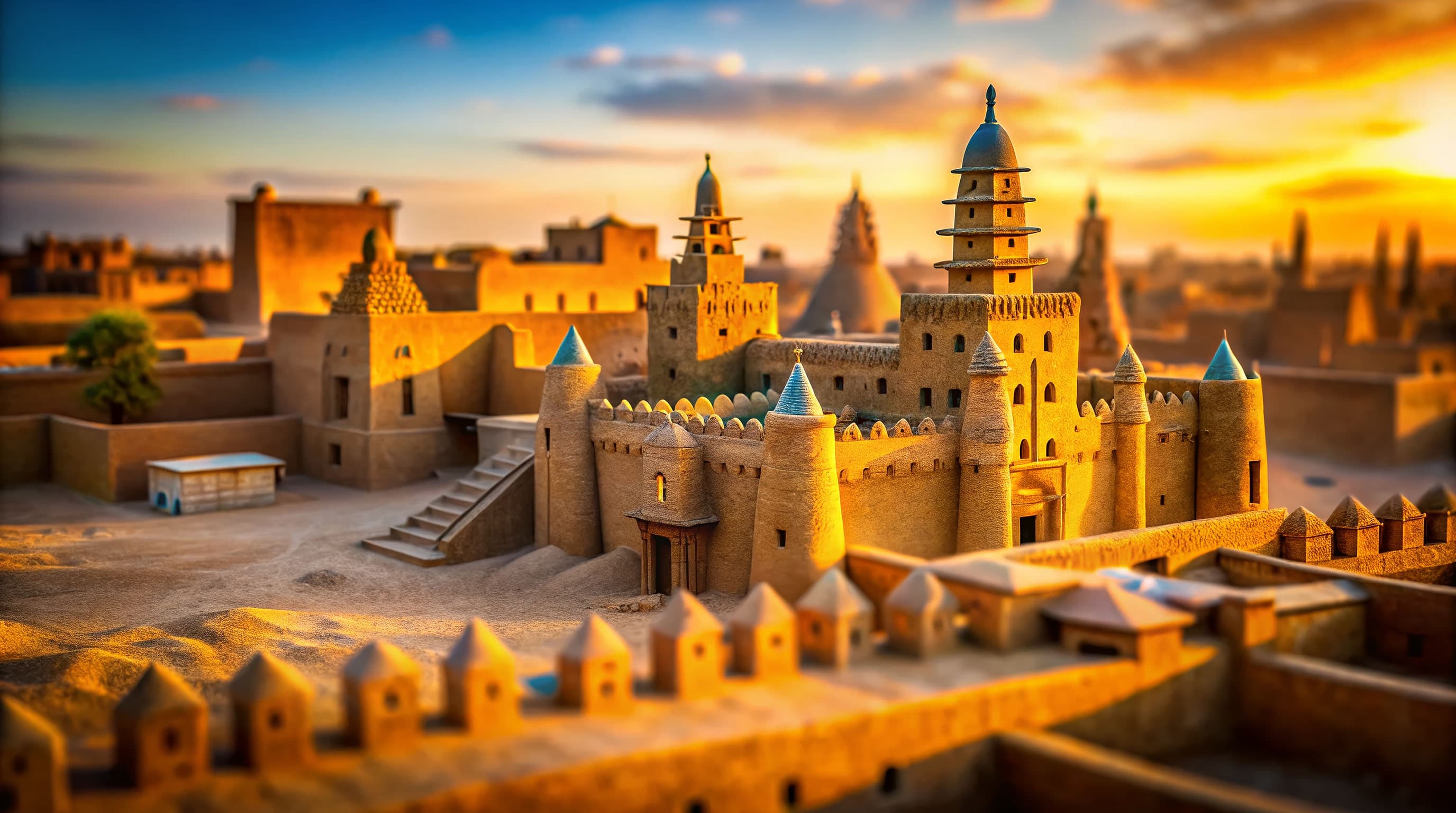
There exists, at the edge of the Sahara Desert, a city whose name once made merchants tremble with anticipation and scholars journey for months across burning sands to reach. Timbuktu is not a myth. It is a real city, in present-day Mali, and for centuries it was one of the most important centres of Islamic learning and civilisation the world has ever known.
A City Born from Trade
Timbuktu was established around the 5th century AH (11th century CE) by Tuareg nomads as a seasonal encampment near the great bend of the Niger River. Its location, at the crossroads between the Sahara and the fertile Sahel, connecting North Africa to the wealth of West Sudan, quickly transformed it into one of the most strategically valuable points on the continent.
Through Timbuktu passed some of the most prized commodities of the medieval world:
- Gold. Mined in the empires of Mali and Songhai, it travelled northward through Timbuktu to the Mediterranean world, making the city synonymous in European imagination with unimaginable wealth.
- Salt. Essential for life and preservation, it came southward from the Saharan mines of Taghaza, exchanged for gold at near-equal weight.
- Knowledge. Perhaps the most precious commodity of all, it flowed in every direction through the scholars, manuscripts, and students who made Timbuktu their home.
The Golden Age: A City of Light
The intellectual height of Timbuktu came in the 14th and 15th centuries CE. Under the patronage of the Mali Empire, particularly after Sultan Mansa Musa's legendary pilgrimage to Makkah in 1324, during which he brought scholars and architects back to West Africa, Timbuktu was transformed into a true city of learning.
At its peak, the city housed nearly 200 Qur'anic schools providing foundational Islamic education, while the Sankore Mosque functioned as a university attracting scholars from across the Islamic world, from the Maghreb, Egypt, Andalusia, and beyond. At its height, Timbuktu is estimated to have had 25,000 students within a total population of roughly 100,000, one of the highest concentrations of scholarly activity anywhere on earth at the time.
This legacy was not incidental. It was the fruit of a community that had taken the words of the Prophet ﷺ to heart:
"If Allah wants to do good to a person, He makes him comprehend the religion."
(Sahih al-Bukhari 71, Book 3, Hadith 13)
The Manuscripts: Africa's Written Heritage
Perhaps the most powerful rebuttal to any notion of an "unwritten" African past is the treasure preserved in Timbuktu's libraries. Over 300,000 manuscripts, written in Arabic and local African languages, survive in the city's private and public collections. Their subjects span the full breadth of Islamic and human knowledge:
- Qur'anic sciences, tafsir, and fiqh (Islamic jurisprudence)
- Hadith and usul al-fiqh (principles of Islamic law)
- History, biography, and genealogy
- Medicine, astronomy, mathematics, and philosophy
- Poetry, literature, and linguistics
These manuscripts are concrete proof of a sophisticated, literate civilisation that engaged with the full range of human inquiry, and did so centuries before much of Europe had access to the same knowledge.
Among Timbuktu's greatest scholars was Ahmad Baba al-Timbukti (1556–1627), a jurist of the Maliki school who authored over forty works and was recognised across the Islamic world for his scholarship. Upon his forced exile to Marrakesh, he lamented that he had left behind 1,600 of his own books in Timbuktu, and that this was the least of any of his relatives. The libraries of Timbuktu were not the exception. They were the norm.
Islam in Africa: Not Imported, but Cultivated
What Timbuktu demonstrates above all else is that Islam in West Africa was a civilisation that African Muslims built, developed, and gave back to the world. The city embodies the Qur'anic vision of a community devoted to knowledge and reflection:
"Is one who worships devoutly during the hour of the night prostrating himself or standing (in adoration), who takes heed of the Hereafter, and who places his hope in the Mercy of his Lord - (like one who does not)? Say: "Are those equal, those who know and those who do not know? It is those who are endued with understanding that receive admonition."
(Surah Az-Zumar, 39:9)
And the city embodied a model of coexistence between local traditions and Islamic teachings, bringing together various African ethnicities including the Tuareg, Songhai, and Fula peoples into a single thriving society united by faith and learning.
Timbuktu Today
The city has faced profound challenges in recent centuries, the Moroccan invasion of 1591 disrupted its scholarly networks, and colonial rule marginalised its heritage. Most recently, during the extremist occupation of 2012, irreplaceable manuscripts were threatened with deliberate destruction. In one of the most courageous acts of cultural preservation in modern history, Malian scholars risked their lives to smuggle hundreds of thousands of documents to safety in Bamako. The manuscripts survived.
Timbuktu today is a UNESCO World Heritage Site. Its three great mosques, Djinguereber, Sankore, and Sidi Yahia, still stand as they have stood for centuries. Its story is still being told.
A Symbol for Our Times
Timbuktu is a reminder that Africa has always been a land of scholarship, of light, and of Islamic civilisation. It speaks to every African Muslim who has been led to believe that their heritage is peripheral to Islam, and says clearly: your ancestors were among the torchbearers of this faith.
The scholars of Timbuktu built entire cities around the pursuit of knowledge. May Allah preserve their legacy, revive it in the hearts of their descendants, and bless the African Muslim Ummah with scholars who carry forward that centuries-long tradition of devotion to learning and to Allah.