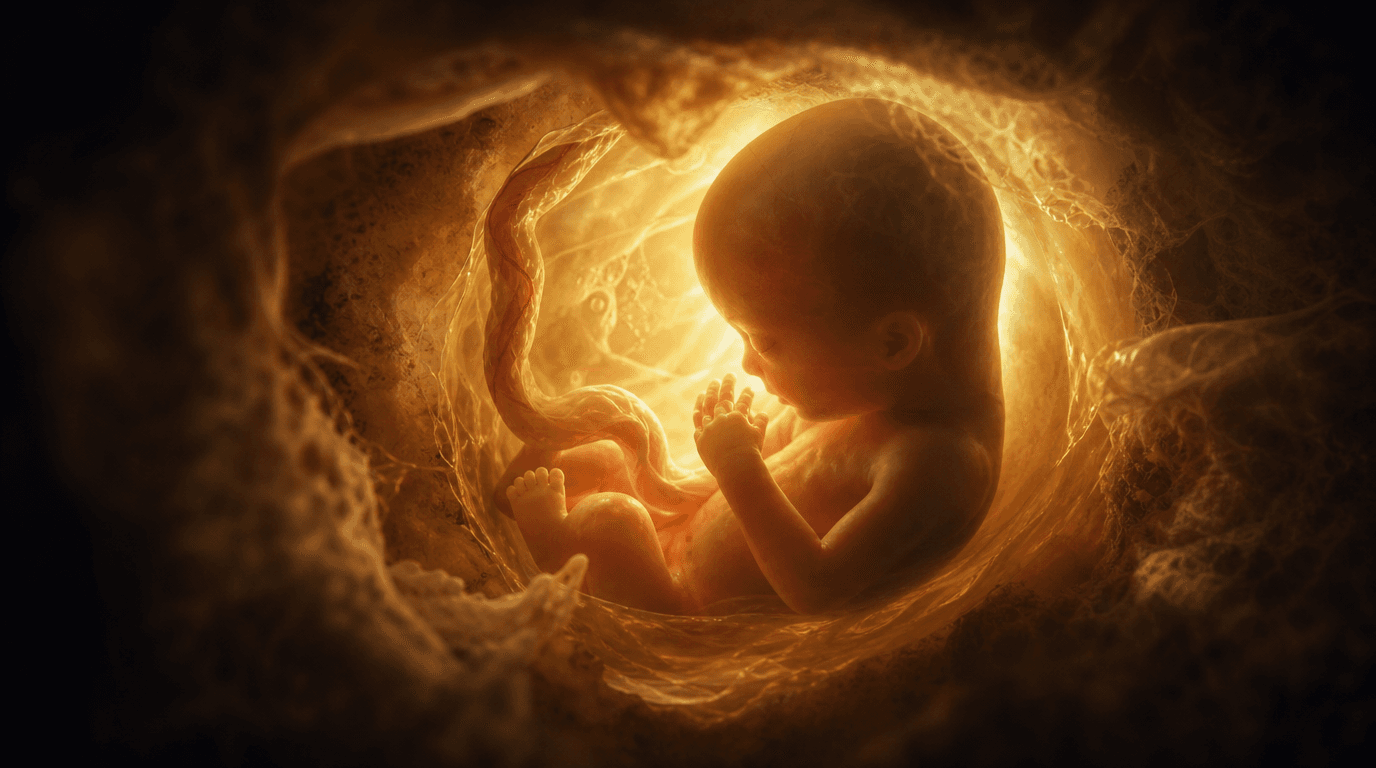
Where do we come from? The Qur'an answers this question not once but many times, returning again and again to the hidden journey each of us made inside our mother, describing it as a passage through distinct, ordered stages. For a book revealed in the 7th century, without any of the instruments that would later make the womb visible, these descriptions are among the most remarkable of the Qur'an's "signs."
The Stages of Creation
The central passage appears in Surah Al-Mu'minun, where the Qur'an lays out the development of the human being step by step:
"Man We did create from a quintessence (of clay); Then We placed him as (a drop of) sperm in a place of rest, firmly fixed; Then We made the sperm into a clot of congealed blood; then of that clot We made a (foetus) lump; then we made out of that lump bones and clothed the bones with flesh; then we developed out of it another creature. So blessed be Allah, the best to create!"
(Surah Al-Mu'minun, 23:12–14)
Muslims have long marvelled at the ordered precision of this description. The Arabic terms are rich in meaning:
- Nutfah. A "drop," referring to the fluid from which conception begins.
- 'Alaqah. A word that carries the meanings of something that clings, a leech-like form, and a clot of blood. Muslims note how aptly this describes the early embryo, which clings to the wall of the womb.
- Mudghah. A "chewed lump," evoking a small mass of tissue.
- Then the forming of bones, which are subsequently clothed with flesh. An ordering of skeleton then muscle.
- Finally, being "developed into another creation", brought forth as a new, complete being.
A Description Beyond Its Age
What strikes Muslim readers is not only the ordering of the sequence but its very existence in a 7th-century desert text. The prevailing ideas about human origins in the ancient world were often crude or mistaken. The Qur'an, by contrast, presents a calm, ordered progression that believers find remarkable to encounter in a book of that age: a drop, a clinging form, a lump, bones, then flesh.
It is worth being clear about how Muslims read these verses. They are not presented here as a modern embryology textbook, nor as a scientific "proof" to settle a laboratory debate, the exact correspondence of ancient terms to modern biological stages is discussed and interpreted in different ways. Rather, they are read as signs: descriptions of our own hidden beginnings that many Muslims find striking, and that invite reflection on the One who shaped us. It is in that spirit that this chapter is offered.
The Qur'an makes the same point elsewhere, framing the stages as an argument for the reality of the Creator and the resurrection:
"O mankind! if ye have a doubt about the Resurrection, (consider) that We created you out of dust, then out of sperm, then out of a leech-like clot, then out of a morsel of flesh, partly formed and partly unformed, in order that We may manifest (our power) to you; and We cause whom We will to rest in the wombs for an appointed term, then do We bring you out as babes, then (foster you) that ye may reach your age of full strength; and some of you are called to die, and some are sent back to the feeblest old age, so that they know nothing after having known (much), and (further), thou seest the earth barren and lifeless, but when We pour down rain on it, it is stirred (to life), it swells, and it puts forth every kind of beautiful growth (in pairs)."
(Surah Al-Hajj, 22:5)
Created in Stages, in Threefold Darkness
Another verse describes the unborn child developing through successive stages, hidden within "three darknesses", understood by many as the layers that envelop and protect the growing child within the mother:
"He created you (all) from a single person: then created, of like nature, his mate; and he sent down for you eight head of cattle in pairs: He makes you, in the wombs of your mothers, in stages, one after another, in three veils of darkness. such is Allah, your Lord and Cherisher: to Him belongs (all) dominion. There is no god but He: then how are ye turned away (from your true Centre)?"
(Surah Az-Zumar, 39:6)
The phrase "creation after creation" captures the Qur'an's consistent picture: not a single instant, but a developing process, stage following stage.
The Purpose of These Verses
As with all the Qur'an's "signs," these passages are not offered as a biology lesson for its own sake. They are an argument for gratitude and humility: that the God who fashioned you, unseen, from a single drop into a hearing, seeing human being is surely able to raise you again, and is worthy of your worship.
"Then We made the sperm into a clot of congealed blood; then of that clot We made a (foetus) lump; then we made out of that lump bones and clothed the bones with flesh; then we developed out of it another creature. So blessed be Allah, the best to create!"
(Surah Al-Mu'minun, 23:14)
For Muslims, to read of one's own beginnings in the words of the Qur'an is to feel known by the One who wrote them, the same One who shaped each of us in the dark, stage by stage.
Further Reading
- The Qur'an. Read it for yourself, with translation and recitation.
- Sahih al-Bukhari & Sahih Muslim. The two most rigorously authenticated collections of the Prophet's ﷺ sayings.
- Riyad as-Salihin (Imam an-Nawawi), a beloved anthology of hadith on faith, character, and worship.
- The Sealed Nectar (Ar-Raheeq Al-Makhtum), an award-winning biography of the Prophet ﷺ.
- Muhammad: His Life Based on the Earliest Sources. Martin Lings.