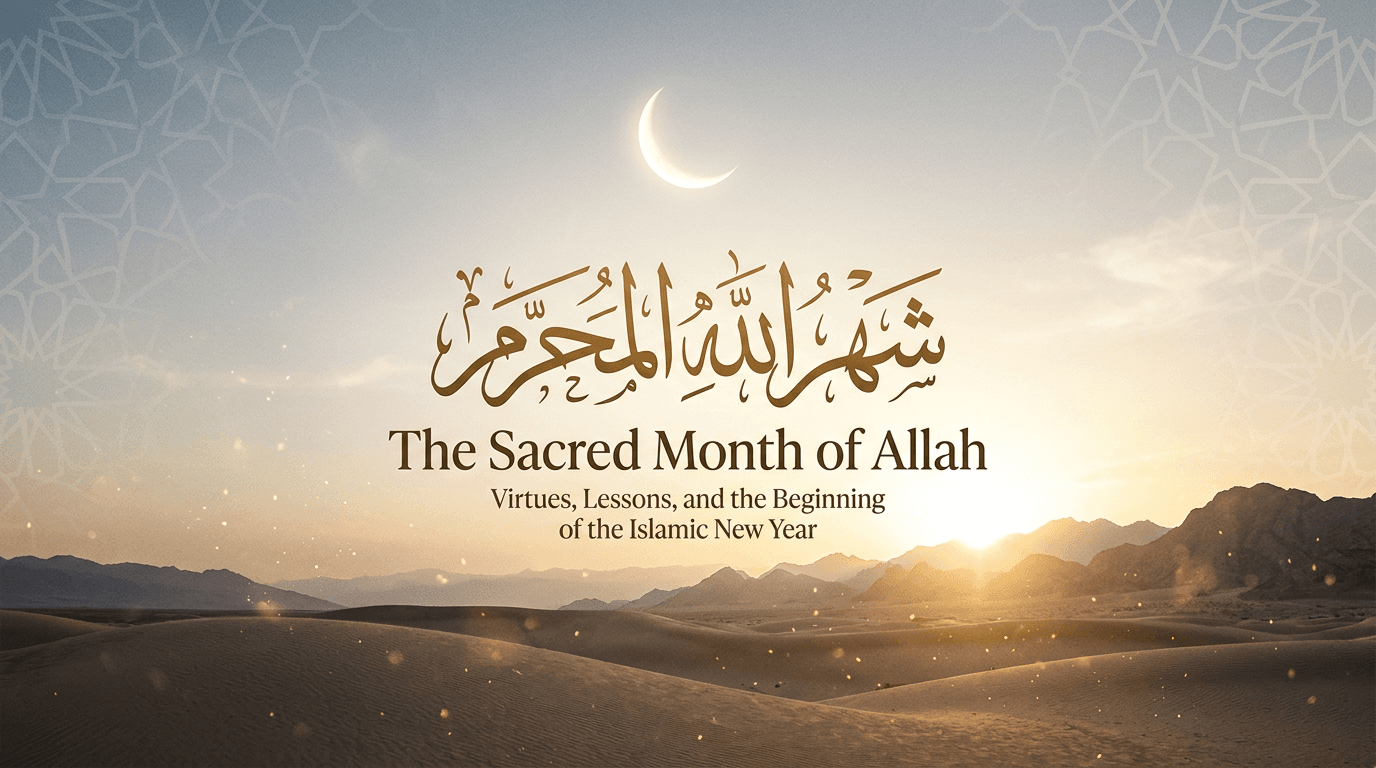
As the sun sets on the final day of Dhul Hijjah, the Muslim world turns the page to a new year. The first month of that year is Muharram, a month Allah Himself has honoured, calling it "the Sacred Month of Allah." It is a time of reflection, renewal, and one of the most beloved fasts in the entire calendar. For the believer seeking a strong start to the year, Muharram is a gift not to be missed.
Muharram: One of the Four Sacred Months
Allah, the Most High, declares in His Book:
"The number of months in the sight of Allah is twelve (in a year)- so ordained by Him the day He created the heavens and the earth; of them four are sacred: that is the straight usage. So wrong not yourselves therein, and fight the Pagans all together as they fight you all together. But know that Allah is with those who restrain themselves."
(Surah At-Tawbah, 9:36)
The Prophet ﷺ named these four sacred months:
"(The division of time has turned to its original form which was current when Allah created the Heavens and the Earths.) The year is of twelve months, out of which four months are sacred: Three are in succession, Dhul-Qa'da, Dhul-Hijja and Muharram, and (the fourth is) Rajab of (the tribe of) Mudar which comes between Jumadi-ath-Thaniyah and Sha'ban."
(Sahih al-Bukhari 3197, Book 59, Hadith 8)
During these months, both good deeds and sins carry greater weight. Ibn Kathir (may Allah have mercy on him) noted that wrongdoing in the sacred months is more serious, while acts of obedience, prayer, fasting, charity, and remembrance, yield a far greater reward. Muharram, opening the year, invites us to begin with taqwa and intention.
"The Month of Allah"
Of all the months, Muharram carries a unique honour, the Prophet ﷺ attributed it directly to Allah:
"The most excellent fast after Ramadan is God's month, al-Muharram."
(Sahih Muslim 1163a, Book 13, Hadith 261)
The scholars observe that no other month was given this title, Shahrullah, "the month of Allah." This attribution is a mark of its elevated rank, and it is why voluntary fasting in Muharram is the most virtuous fasting outside of Ramadan.
The Day of Ashura: the 10th of Muharram
The crown of Muharram is the Day of Ashura, the tenth day of the month. Its fast is among the most rewarding a believer can offer in the entire year.
When the Prophet ﷺ arrived in Madinah, he found the Jews fasting on Ashura. He asked them why, and they replied that it was the day Allah saved Musa (Moses) and the Children of Israel from Pharaoh, so Musa fasted it in gratitude. The Prophet ﷺ said:
"We have more right to Musa than you," and he fasted it and ordered the people to fast it.
(Sahih al-Bukhari 2004, Book 30, Hadith 109; Sahih Muslim 1130a, Book 13, Hadith 162)
The reward for fasting this single day is immense:
"I seek from Allah that fasting on the day of Ashura may atone for the sins of the preceding year."
(Sahih Muslim 1162a, Book 13, Hadith 252)
One day of fasting, and a year of minor sins wiped clean. Few acts of worship offer so great a reward for so little.
Fast Tasu'a Too: the 9th of Muharram
In the final year of his life, the Prophet ﷺ expressed his intention to distinguish the Muslims' fast from that of the People of the Book by fasting the ninth day as well:
"When the next year comes, God willing, we would observe fast on the 9th."
(Sahih Muslim 1134a, Book 13, Hadith 172)
He passed away before the next Muharram, but his intention became a Sunnah. So the recommended practice is to fast both the 9th and the 10th (Tasu'a and Ashura). If one is only able to fast a single day, the 10th alone still carries the full reward of expiating the previous year.
The Three Levels of Fasting Ashura
The scholars, including Ibn al-Qayyim (may Allah have mercy on him), described three levels of completeness:
- Best: Fast the 9th, 10th, and 11th of Muharram.
- Better: Fast the 9th and the 10th.
- Acceptable: Fast the 10th alone.
The Islamic New Year
The first of Muharram marks the beginning of the Hijri (Islamic) calendar. This calendar is dated not from a battle or a coronation, but from the Hijrah, the migration of the Prophet ﷺ from Makkah to Madinah. It was Umar ibn al-Khattab (may Allah be pleased with him) who, in consultation with the Companions, established the Hijrah as the starting point of the Muslim era, a powerful statement that our history turns on the moment faith found a home.
There is no specific act of worship the Prophet ﷺ prescribed for the night or day of the new year, no special prayer, no celebration. Rather, the believer welcomes it the way every day should be welcomed: with gratitude, sincere intention, and a resolve to draw nearer to Allah. The change of the year is a natural moment to pause, take account of oneself, and set the heart in order for the months ahead.
Umar ibn al-Khattab (may Allah be pleased with him) said: "Take account of yourselves before you are taken to account, and weigh your deeds before they are weighed for you."
What to Do in Muharram
- Fast Ashura (10th), and Tasu'a (9th) with it. The single most emphasised act of the month.
- Increase voluntary fasting throughout the month. It is "the best fasting after Ramadan."
- Begin the year with sincere repentance (tawbah) and a renewed intention to obey Allah.
- Guard against sin. Wrongdoing in a sacred month is graver.
- Increase in dhikr, Qur'an, charity, and du'a as the year begins.
- Take account of yourself. Reflect on the year that passed and set goals for the year ahead.
A Beautiful Beginning
Muharram offers the believer a rare combination: the honour of a sacred month, the immense reward of fasting Ashura, and the fresh page of a new year. It is a season to step into the year with a clean heart, a clear intention, and hope in the mercy of Allah.
As one year closes and another opens, may Allah make the year ahead one of forgiveness, steadfastness, and nearness to Him, and may He accept our fasting and our repentance. Ameen.
The Islamic calendar begins with the Hijrah — the migration that changed the course of history. Read the full story and its timeless lessons: The Hijrah — The Migration That Changed History.