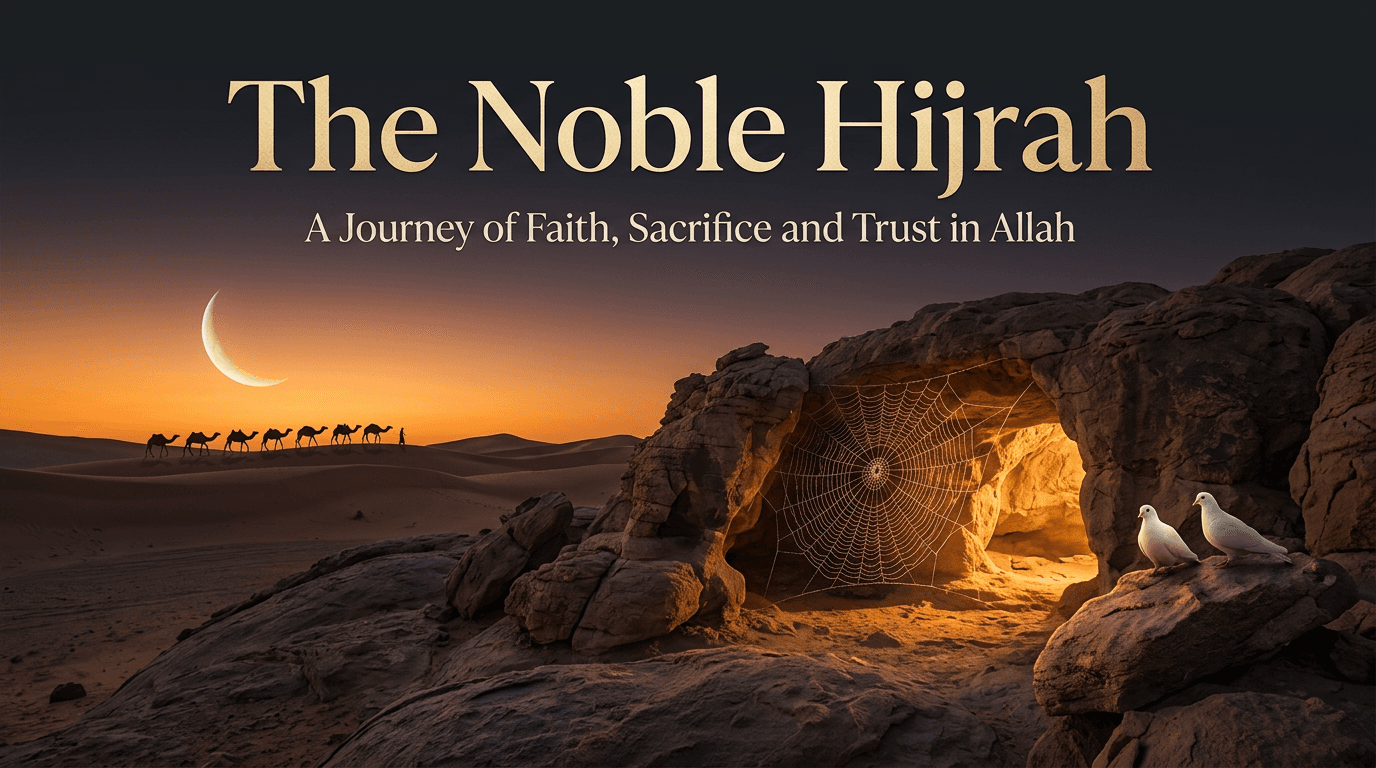
Of all the events in Islamic history, few carry the weight of the Hijrah, the migration of the Prophet Muhammad ﷺ from Makkah to Madinah. It marked the birth of the first Muslim community, the dawn of the Islamic state, and a turning point so significant that the Muslims would later date their entire calendar from it. The new Hijri year that we now welcome takes its name from this very journey.
Thirteen Years of Patience
For thirteen long years in Makkah, the Prophet ﷺ and his followers endured persecution, boycott, torture, and exile for no crime other than saying "There is no god but Allah." Believers were beaten, starved, and killed. Yet through it all, the Prophet ﷺ remained patient and steadfast, calling people to the truth.
When the people of Yathrib (later Madinah) embraced Islam and pledged to protect the Prophet ﷺ, Allah finally granted permission to migrate. One by one, the Muslims slipped out of Makkah toward their new home, until only the Prophet ﷺ, Abu Bakr, and Ali (may Allah be pleased with them) remained.
The Plot and the Night of Departure
The leaders of Quraysh, alarmed, gathered and hatched a plot: a young man from every clan would strike the Prophet ﷺ together, so that his blood would be on all of them and his family could not seek revenge. Allah revealed their scheme:
"Remember how the Unbelievers plotted against thee, to keep thee in bonds, or slay thee, or get thee out (of thy home). They plot and plan, and Allah too plans; but the best of planners is Allah."
(Surah Al-Anfal, 8:30)
On the appointed night, the assassins surrounded his house. But the Prophet ﷺ asked Ali (may Allah be pleased with him) to sleep in his bed, and he walked out past them unseen, leaving for the home of Abu Bakr. The two set out together under the cover of night.
The Cave of Thawr
Rather than head north to Madinah, the Prophet ﷺ and Abu Bakr travelled south, a brilliant move to throw off their pursuers, and took refuge in a cave on Mount Thawr. Quraysh offered a fortune for their capture, and search parties combed the area. At one point, the pursuers stood at the very mouth of the cave.
Abu Bakr (may Allah be pleased with him) grew afraid, not for himself, but for the Messenger of Allah ﷺ. He whispered, "If one of them looks down at his feet, he will see us." The Prophet ﷺ replied with words of perfect trust in Allah:
"If ye help not (your leader), (it is no matter): for Allah did indeed help him, when the Unbelievers drove him out: he had no more than one companion; they two were in the cave, and he said to his companion, "Have no fear, for Allah is with us": then Allah sent down His peace upon him, and strengthened him with forces which ye saw not, and humbled to the depths the word of the Unbelievers. But the word of Allah is exalted to the heights: for Allah is Exalted in might, Wise."
(Surah At-Tawbah, 9:40)
And in another narration:
"O Abu Bakr! What do you think of two (persons) the third of whom is Allah?"
(Sahih al-Bukhari 3653, Book 62, Hadith 5)
The pursuers turned away, and the two remained in the cave for three nights before continuing their journey.
Suraqah and the Sinking Horse
As they journeyed on, Suraqah ibn Malik gave chase, hoping to win the reward for capturing them. But each time his horse drew near, its legs sank into the ground. Realising he was facing something greater than a fugitive, Suraqah begged for safety. The Prophet ﷺ, even in this moment of danger, foretold that Suraqah would one day wear the bracelets of Khosrow, the emperor of Persia. Years later, after the Muslim conquests, that very prophecy came true. (Sahih al-Bukhari 3906)
The First Masjid: Quba
Arriving safely on the outskirts of Madinah, the Prophet ﷺ first stopped at Quba, where he established the very first masjid of Islam, a masjid Allah Himself praised:
"Never stand thou forth therein. There is a mosque whose foundation was laid from the first day on piety; it is more worthy of the standing forth (for prayer) therein. In it are men who love to be purified; and Allah loveth those who make themselves pure."
(Surah At-Tawbah, 9:108)
The Welcome of Madinah
As the Prophet ﷺ entered Madinah, the city erupted in joy. The Ansar, the Helpers, came out to greet him with celebration and song, their hearts overflowing that the Messenger of Allah ﷺ had finally come to live among them. It was the happiest day Madinah had ever known.
There, the Prophet ﷺ laid the foundations of a new society. He built the Prophet's Mosque (Al-Masjid an-Nabawi), and, in one of the most remarkable acts of unity in history, he established a bond of brotherhood (mu'akhah) between the Muhajirun (the emigrants from Makkah) and the Ansar (the Helpers of Madinah). The Ansar shared their homes, wealth, and land with their brothers in faith, asking nothing in return. (Sahih al-Bukhari 3937)
Allah immortalised their sacrifice and love:
"But those who before them, had homes (in Medina) and had adopted the Faith,- show their affection to such as came to them for refuge, and entertain no desire in their hearts for things given to the (latter), but give them preference over themselves, even though poverty was their (own lot). And those saved from the covetousness of their own souls,- they are the ones that achieve prosperity."
(Surah Al-Hashr, 59:9)
Why the Calendar Begins with the Hijrah
Years later, during the caliphate of Umar ibn al-Khattab (may Allah be pleased with him), the Muslims needed a fixed starting point for their calendar. After consulting the Companions, Umar chose not the Prophet's birth, nor the first revelation, nor a great victory, but the Hijrah.
Why? Because the Hijrah was the moment Islam moved from a persecuted message to an established community, the moment faith found a home and a future. It was a turning point not of one man's life, but of the entire Ummah. To this day, every Hijri date we write is a quiet tribute to that journey.
The Hijrah Within Us
The lessons of the Hijrah speak to every believer in every age:
- Trust in Allah's plan. "Do not grieve; indeed Allah is with us." Even when surrounded by danger, the believer's heart rests in Allah.
- Take the means, then rely on Allah. The Prophet ﷺ planned carefully, a guide, a different route, a hiding place, and then trusted Allah completely. Faith and effort go together.
- Brotherhood over self. The Ansar gave preference to others over themselves. True faith is generous.
- Sacrifice for what matters. The Muhajirun left their homes, wealth, and birthplace for the sake of Allah, and Allah replaced it with something far greater.
The Prophet ﷺ taught that the spirit of migration continues long after the journey itself:
"A Muhajir (emigrant) is the one who gives up (abandons) all what Allah has forbidden."
(Sahih al-Bukhari 10, Book 2, Hadith 3)
And he reminded us that every deed, including migration, is judged by intention:
"(The value of) an action depends on the intention behind it. A man will be rewarded only for what he intended. The emigration of one who emigrates for the sake of Allah and His Messenger (ﷺ) is for the sake of Allah and His Messenger (ﷺ)."
(Sahih Muslim 1907a, Book 33, Hadith 222)
A New Year, A New Journey
As we welcome a new Hijri year, the Hijrah invites each of us to make our own migration, not from one city to another, but from heedlessness to mindfulness, from sin to repentance, from distraction to devotion. The believer is always on a journey toward Allah.
May Allah make this year a Hijrah of the heart for all of us, a year in which we draw closer to Him, leave behind what displeases Him, and find, as the Companions did, that whatever we give for His sake, He repays with something far better. Ameen.
The new year opens with the sacred month of Muharram and the great fast of Ashura. Read more: Muharram — The Sacred Month and the Islamic New Year.