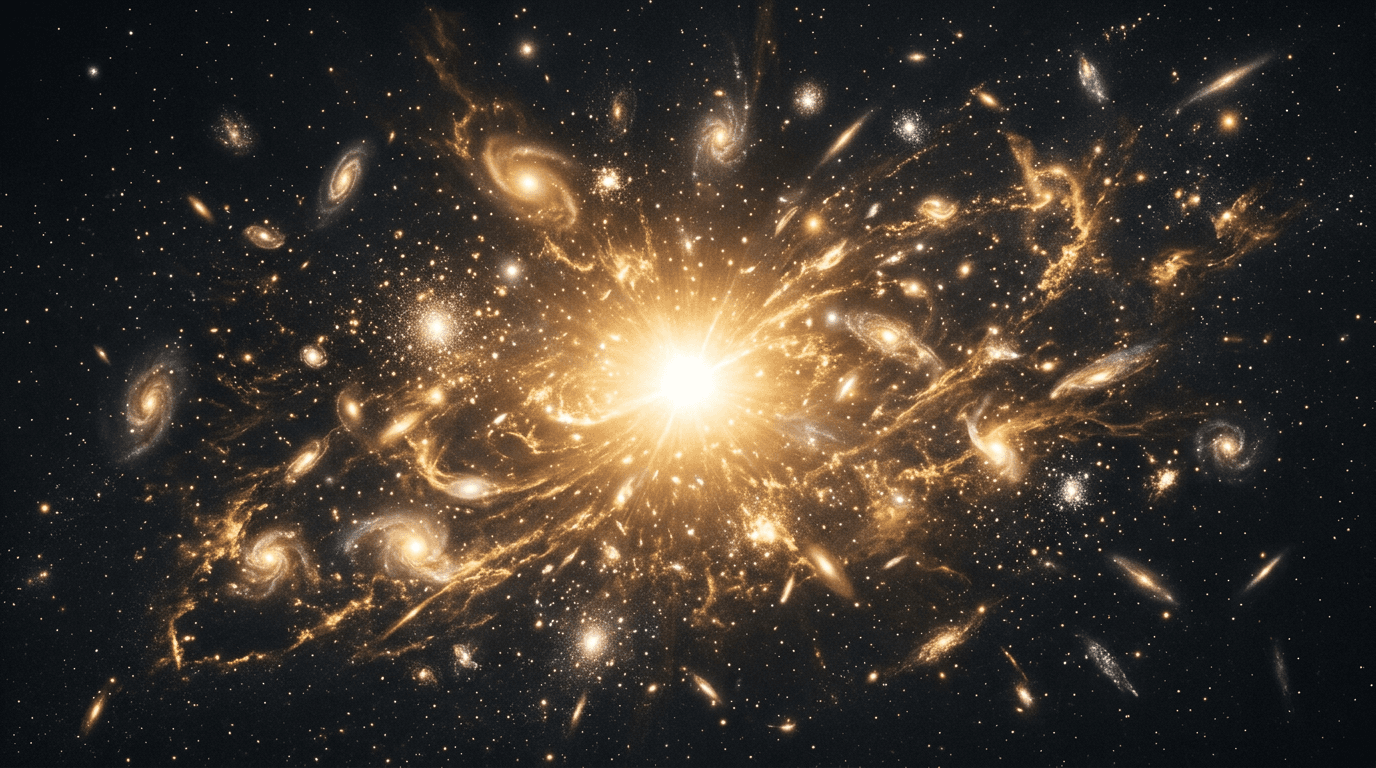
The question of how the universe began is among the oldest that humanity has asked. The Qur'an, revealed in 7th-century Arabia, addresses it in several remarkable verses, describing a beginning to the cosmos, a primordial unity that was then torn apart, and a sky in continual expansion.
The Heavens and Earth Were Once Joined
In one of its most discussed verses, the Qur'an describes the heavens and the earth as having originally been a single, joined entity that God then separated:
"Do not the Unbelievers see that the heavens and the earth were joined together (as one unit of creation), before we clove them asunder? We made from water every living thing. Will they not then believe?"
(Surah Al-Anbiya, 21:30)
Muslims note the striking picture this paints: a single mass, then a separation from which the cosmos as we know it emerged. For a book delivered to an unlettered man among a people with no cosmology beyond myth, believers regard this description as far ahead of its time.
A Sky That Is Expanding
Elsewhere, the Qur'an describes the heaven not as a fixed dome, the common picture in the ancient world, but as something God built with power and is expanding:
"With power and skill did We construct the Firmament: for it is We Who create the vastness of space."
(Surah Adh-Dhariyat, 51:47)
The idea of a static, unchanging cosmos dominated human thought for most of history. The Qur'an's image of a heaven that is being "expanded" stands out against that backdrop, and Muslims have long reflected on the depth of this description.
Creation in Stages, Not by Accident
The Qur'an consistently presents the universe as the deliberate work of a wise Creator, ordered and purposeful, not the product of chance. It describes the shaping of the heavens and the earth as unfolding in measured stages ("days," a word the Qur'an also uses for long periods):
"It is Allah Who has created the heavens and the earth, and all between them, in six Days, and is firmly established on the Throne (of Authority): ye have none, besides Him, to protect or intercede (for you): will ye not then receive admonition?"
(Surah As-Sajdah, 32:4)
And it points to the precision and balance of the cosmos as evidence of a single, wise hand behind it:
"He Who created the seven heavens one above another: No want of proportion wilt thou see in the Creation of (Allah) Most Gracious. So turn thy vision again: seest thou any flaw? Again turn thy vision a second time: (thy) vision will come back to thee dull and discomfited, in a state worn out."
(Surah Al-Mulk, 67:3–4)
Everything Made from Water
The same verse that speaks of the separation of the heavens and earth adds another statement: that God made "from water every living thing" (21:30). The Qur'an returns to this theme repeatedly, presenting water as the origin and sustainer of all life:
"And Allah has created every animal from water: of them there are some that creep on their bellies; some that walk on two legs; and some that walk on four. Allah creates what He wills for verily Allah has power over all things."
(Surah An-Nur, 24:45)
The Purpose Behind the Cosmos
For the Qur'an, the origin of the universe is never merely a scientific curiosity. It is an argument: that such vastness, order, and beauty did not arise on its own, and that reflecting upon it should lead the honest observer back to its Creator.
"It is He Who created the Night and the Day, and the sun and the moon: all (the celestial bodies) swim along, each in its rounded course."
(Surah Al-Anbiya, 21:33)
Further Reading
- The Qur'an. Read it for yourself, with translation and recitation.
- Sahih al-Bukhari & Sahih Muslim. The two most rigorously authenticated collections of the Prophet's ﷺ sayings.
- Riyad as-Salihin (Imam an-Nawawi), a beloved anthology of hadith on faith, character, and worship.
- The Sealed Nectar (Ar-Raheeq Al-Makhtum), an award-winning biography of the Prophet ﷺ.
- Muhammad: His Life Based on the Earliest Sources. Martin Lings.