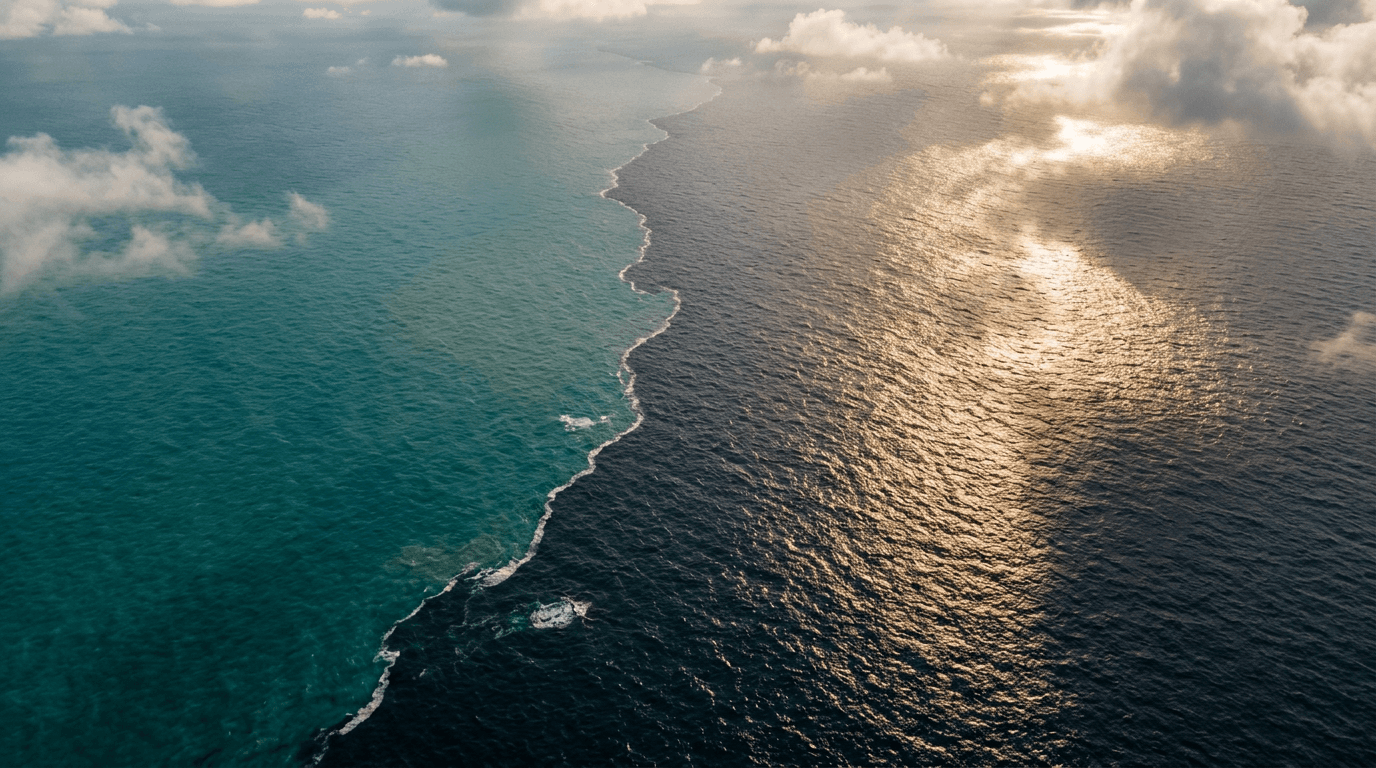
Anyone who has stood where a river pours into the ocean, or where two currents meet, may have noticed something strange: the waters can appear to keep their own colour and character for a time, as if reluctant to mix. The Qur'an describes exactly this phenomenon, and attributes it to an unseen barrier placed between the waters by God.
Two Seas That Meet but Do Not Merge
In a striking pair of verses, the Qur'an describes two bodies of water that flow side by side, meeting one another, yet separated by a boundary they do not cross:
"He has let free the two bodies of flowing water, meeting together: Between them is a Barrier which they do not transgress:"
(Surah Ar-Rahman, 55:19–20)
The image is precise: the two seas meet. They are not kept apart by distance or by land, and yet a barzakh, a barrier or partition, lies between them, preventing either from overwhelming the other. Muslims have long reflected on how aptly this describes what can be observed where different bodies of water come together and, for a time, resist mixing.
Fresh Water and Salt Water
The Qur'an describes this meeting again, this time distinguishing one water as sweet and fresh and the other as salty and bitter, and again places a barrier between them:
"It is He Who has let free the two bodies of flowing water: One palatable and sweet, and the other salt and bitter; yet has He made a barrier between them, a partition that is forbidden to be passed."
(Surah Al-Furqan, 25:53)
This describes precisely the kind of meeting that occurs where rivers flow into seas, fresh water encountering salt water, where the two, though touching, maintain their distinct character across a transitional zone rather than instantly blending into one.
The Bounty That Comes from the Seas
The Qur'an does not describe the seas only as a wonder of physics; it presents them as a source of provision and mercy, and even notes that both the fresh and the salty waters yield good things for humankind:
"It is He Who has made the sea subject, that ye may eat thereof flesh that is fresh and tender, and that ye may extract therefrom ornaments to wear; and thou seest the ships therein that plough the waves, that ye may seek (thus) of the bounty of Allah and that ye may be grateful."
(Surah An-Nahl, 16:14)
Darkness Within the Deep
The Qur'an also paints a vivid picture of the depths of the sea, layers of darkness, waves upon waves, in a description that evokes the crushing, lightless world far below the surface:
"Or (the Unbelievers' state) is like the depths of darkness in a vast deep ocean, overwhelmed with billow topped by billow, topped by (dark) clouds: depths of darkness, one above another: if a man stretches out his hands, he can hardly see it! for any to whom Allah giveth not light, there is no light!"
(Surah An-Nur, 24:40)
For a people of the desert, with little experience of deep oceans, believers find this description of the layered darkness of the deep sea another sign worth pondering.
A Sign in the Waters
As with the mountains and the heavens, the Qur'an presents the seas as āyāt, signs pointing beyond themselves. The meeting of the waters, the barrier between them, the provision they carry, and the darkness of their depths all speak, in the Qur'an's telling, of a Creator whose design is precise and whose mercy is generous.
Further Reading
- The Qur'an. Read it for yourself, with translation and recitation.
- Sahih al-Bukhari & Sahih Muslim. The two most rigorously authenticated collections of the Prophet's ﷺ sayings.
- Riyad as-Salihin (Imam an-Nawawi), a beloved anthology of hadith on faith, character, and worship.
- The Sealed Nectar (Ar-Raheeq Al-Makhtum), an award-winning biography of the Prophet ﷺ.
- Muhammad: His Life Based on the Earliest Sources. Martin Lings.