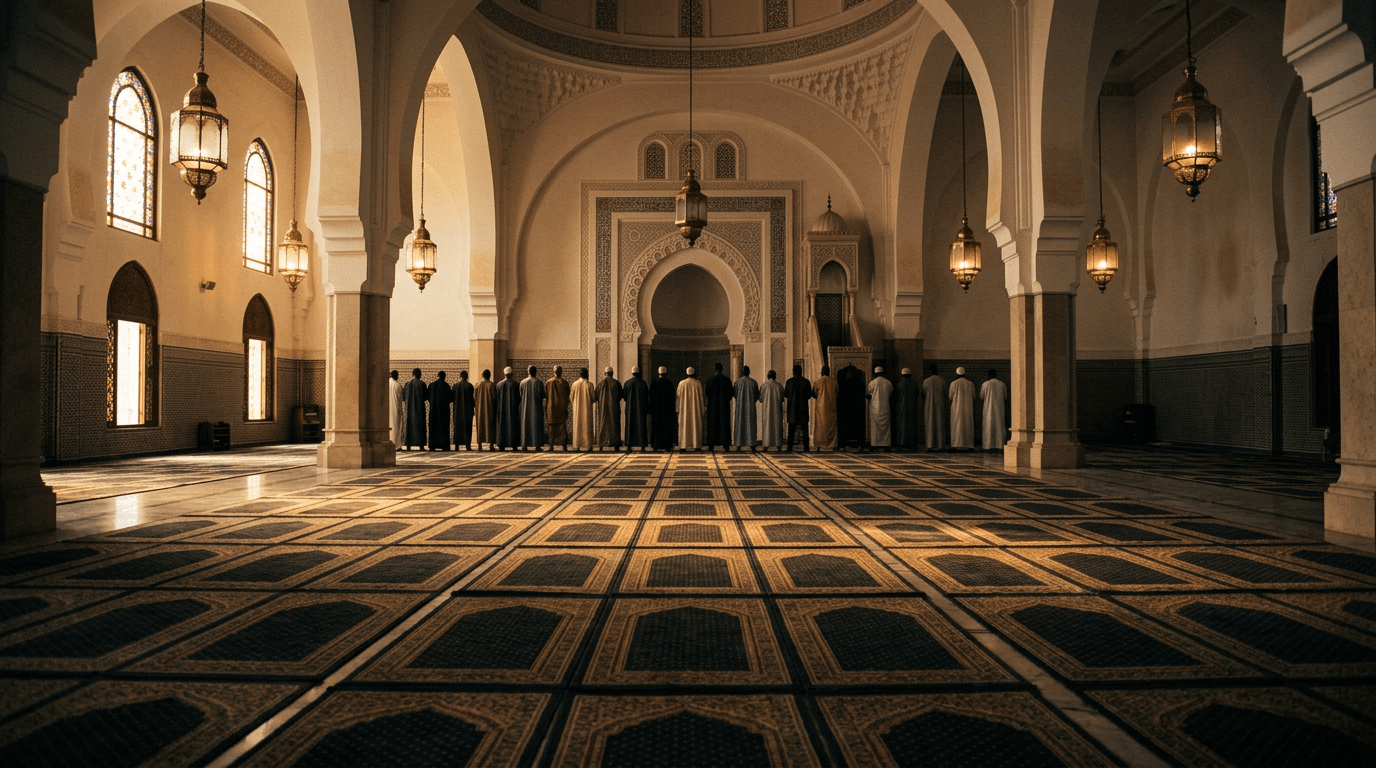
Five times a day, before dawn, at midday, in the afternoon, at sunset, and at night, over a billion Muslims stop whatever they are doing, face the direction of Makkah, and pray. This prayer, called salāh, is the second of the Five Pillars of Islam. But why five times? And what is it for?
Because God Commanded It
The simplest answer comes first: Muslims pray five times a day because Allah commanded it. The Qur'an ties prayer to the movement of the day itself:
"When ye pass (Congregational) prayers, celebrate Allah's praises, standing, sitting down, or lying down on your sides; but when ye are free from danger, set up Regular Prayers: For such prayers are enjoined on believers at stated times."
(Surah An-Nisa, 4:103)
Prayer is the first act of worship a Muslim is asked about, and the Prophet ﷺ described it as the pillar on which the whole structure of the faith stands. It is obligatory on every adult Muslim, man and woman alike.
A Rhythm That Reorders the Day
The five prayers are spread across the day deliberately: Fajr before sunrise, Dhuhr at midday, 'Asr in the afternoon, Maghrib at sunset, and 'Isha at night. Rather than squeezing God into one weekly appointment, Islam weaves remembrance of Him through the whole day. Work, family, and rest all keep their place, but they are punctuated, five times, by a return to the One who gave them.
The Prophet ﷺ offered a beautiful image of what this rhythm does:
"If there was a river at the door of anyone of you and he took a bath in it five times a day would you notice any dirt on him?" They said, "Not a trace of dirt would be left." The Prophet ﷺ added, "That is the example of the five prayers with which Allah blots out (annuls) evil deeds."
(Sahih al-Bukhari 528, Book 9, Hadith 7)
What the Prayer Actually Does
- It keeps the heart connected. Prayer is a direct conversation with God, no priest, no intermediary. "establish regular prayer for celebrating My praise" (Surah Taha, 20:14).
- It restrains wrongdoing. The Qur'an says prayer "restrains from shameful and unjust deeds" (Surah Al-'Ankabut, 29:45), five daily appointments with God make it harder to drift.
- It humbles and equalizes. In the mosque, the wealthy and the poor stand shoulder to shoulder in identical rows, foreheads on the same ground.
- It brings peace. A man once wished aloud that he had prayed and found comfort, and was criticised for saying so. He answered that he had heard the Prophet ﷺ say: "O Bilal, call iqamah for prayer: give us comfort by it." (Sunan Abi Dawud 4985, Book 43, Hadith 213)
In One Sentence
Muslims pray five times a day because God commanded it, and in obeying, they find what the prayer was designed to give: a day threaded with remembrance, a heart washed clean, and rest in the presence of their Creator.
Learn More
- The Five Pillars of Islam Explained. Where prayer fits among the five foundations of Muslim life.
- What Is Islam? A Comprehensive Introduction. The full picture of the faith behind the prayer.
Continue Your Journey
Part of the Bilaal TV Islamic Knowledge Hub.