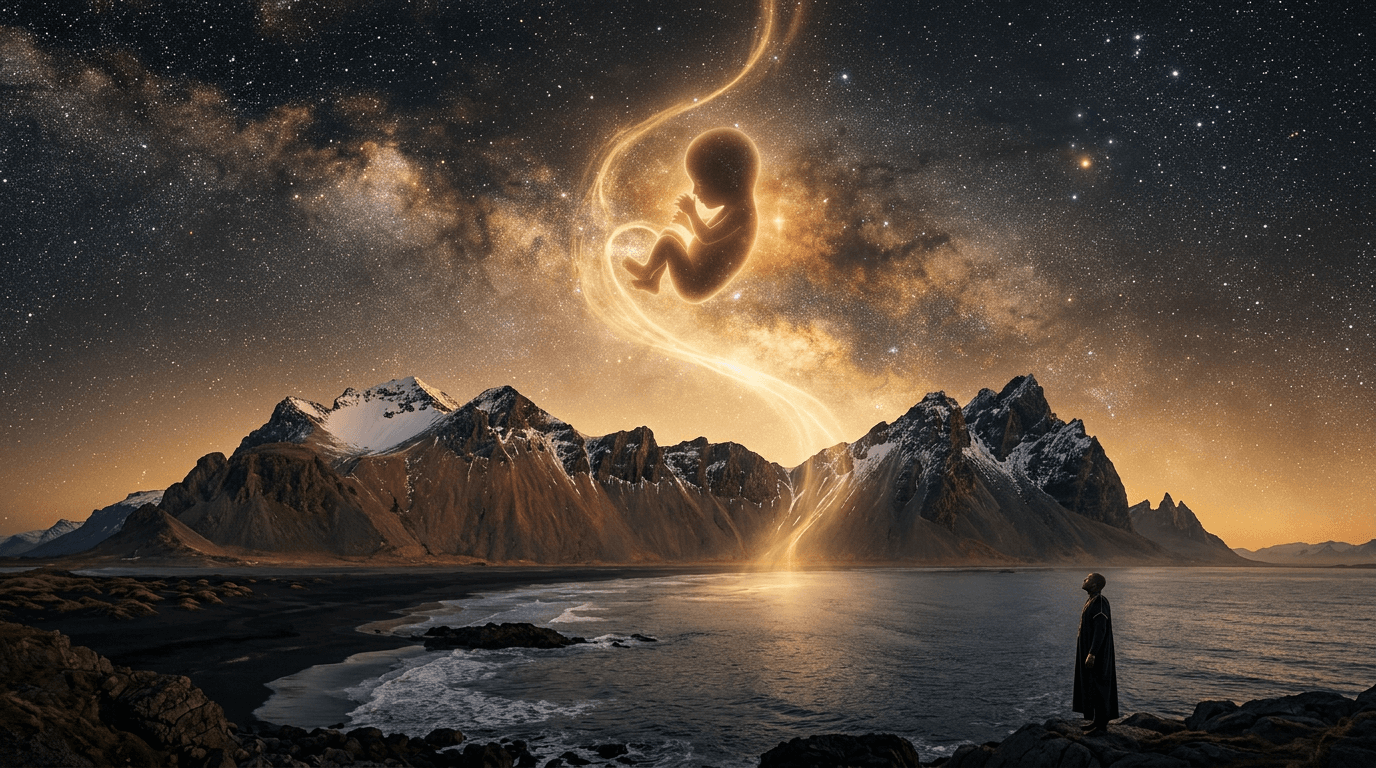
The Qur'an describes itself as a book of guidance, not a manual of physics or biology. And yet, scattered throughout its chapters are striking references to the natural world, the heavens, the earth, the mountains, the oceans, and the origins of life. The Qur'an calls these āyāt, a word that means both "verses" and "signs." The same word is used for a line of scripture and for a wonder in creation, because the Qur'an treats both as pointing to the same Author.
"Behold! in the creation of the heavens and the earth, and the alternation of night and day,- there are indeed Signs for men of understanding,-"
(Surah Aal 'Imran, 3:190)
An Invitation to Observe
More than any other scripture of its age, the Qur'an turns the reader outward, toward the sky, the sea, the mountains, and the body, and asks a recurring question: will you not look? will you not reflect?
"Do they not look at the Camels, how they are made?- And at the Sky, how it is raised high?- And at the Mountains, how they are fixed firm?- And at the Earth, how it is spread out?"
(Surah Al-Ghashiyah, 88:17–20)
This posture, that studying creation is itself a way of coming to know the Creator, helped inspire centuries of Muslim scholarship in astronomy, medicine, mathematics, and the natural sciences during Islam's golden age.
Descriptions Ahead of Their Time
What has drawn particular attention is that a number of the Qur'an's descriptions of the natural world align, in the reading of many Muslims, with knowledge that would not be established until many centuries later, knowledge unavailable to a 7th-century unlettered man in the Arabian desert. Among the most discussed are:
- The origin of the universe. The heavens and the earth described as once joined and then separated, and the sky as "expanding." Read the chapter →
- The development of the human embryo. Described in ordered stages within the mother. Read the chapter →
- The mountains. Described as "pegs" and stabilisers of the earth. Read the chapter →
- The seas. Described as meeting yet held apart by an unseen barrier. Read the chapter →
How Muslims Understand These Signs
It is worth being clear about how the Qur'an itself frames these passages. It does not present them as scientific proofs to be dissected in a laboratory, but as signs, invitations to wonder, meant to move the heart toward its Creator. The Qur'an's language is the language of guidance and reflection, spoken to farmers, traders, and travellers as much as to scholars.
Muslims read these verses as evidence that the One who authored the Qur'an is the same One who authored the natural world, for only the Maker of a thing can describe it truly. The verses were understood and cherished by believers long before modern instruments existed; the growth of scientific knowledge has, for many, only deepened that wonder.
"Soon will We show them our Signs in the (furthest) regions (of the earth), and in their own souls, until it becomes manifest to them that this is the Truth. Is it not enough that thy Lord doth witness all things?"
(Surah Fussilat, 41:53)
The chapters that follow examine four of the most remarkable of these signs, as the Qur'an describes them and as Muslims have reflected on them across the centuries: the birth of the universe, the human embryo, the mountains, and the seas.
Further Reading
- The Qur'an. Read it for yourself, with translation and recitation.
- Sahih al-Bukhari & Sahih Muslim. The two most rigorously authenticated collections of the Prophet's ﷺ sayings.
- Riyad as-Salihin (Imam an-Nawawi), a beloved anthology of hadith on faith, character, and worship.
- The Sealed Nectar (Ar-Raheeq Al-Makhtum), an award-winning biography of the Prophet ﷺ.
- Muhammad: His Life Based on the Earliest Sources. Martin Lings.